

DeepNext – An Open-Source, Autonomous AI Agent for Software Engineering
What if we could work with an AI tool in software engineering as we would with a teammate? Assigning tasks, coding together, giving feedback, providing context, and consulting? These questions inspired us to create DeepNext – an open-source, AI-powered software engineering assistant that has enabled us to delegate 40% of low- and medium-complexity tasks to artificial intelligence.
What is DeepNext?
DeepNext is an open-source, AI-powered junior software engineer that automates and accelerates software development by transforming tasks and issues into ready-to-merge pull requests.
It integrates directly with GitHub, GitLab, and JIRA, behaving like a real teammate who understands requirements, analyzes codebases, proposes solutions, implements changes, and reviews results. It generates Python code, but it can understand all programming languages and various file formats.
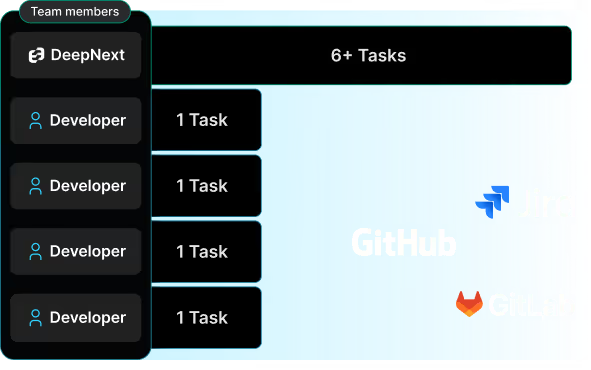
An AI-powered junior software engineer
Building DeepNext, we thought of it as a teammate with whom we could collaborate on everyday tasks. We wanted to create a tool with real value for the engineering team, one that we ourselves would use.
When designing its decision-making process, we asked ourselves, "How would a human approach such a task? What would their decision-making process be? What would they want to know?"
The result was a unique tool that allowed us to delegate 40% of low- and medium-complexity tasks to artificial intelligence.

Tomasz Jach
Head of AI at STX Next
DeepNext was an ambitious R&D experiment that gave us a wealth of practical knowledge – and a lot of fun. We approach AI tools without illusions: they work great for rapid prototyping, code analysis, and relieving developers of repetitive tasks. We use them every day, where they truly speed up work and boost productivity.
At the same time, we know that AI cannot replace the experience of a senior developer. Generated code can be unpredictable, sometimes more challenging to debug than writing a solution from scratch, and for less experienced developers it can even lead to a decline in their “engineering muscle.”
At STX, we build solutions we genuinely want to use ourselves – pragmatic, secure, and resistant to temporary hype. DeepNext proved that we can deliver AI tools that truly support engineers, not just trendy buzzwords, and that we understand both the potential of these models and their limits. When creating DeepNext, we drew on our practical experience in engineering and AI design to build a tool we would actually use.

How does it work
Based on a multi-agent LLM architecture, DeepNext mimics the natural workflow of a human software engineer – from onboarding to planning, implementation, and code review. Instead of generating isolated code snippets, it reasons across the entire repository, understands context, and coordinates specialized AI agents to deliver complete, production-ready code changes.
DeepNext can work in two modes:
Fully autonomous
DeepNext takes a ticket and completes it all by itself, including the end code review.
Human in the loop
Human engineers interact with DeepNext through the planning and implementation process, reviewing its work and introducing direct changes.
All communication with the AI agent happens directly in GitHub/GitLab issue comments – just like interacting with a remote teammate.
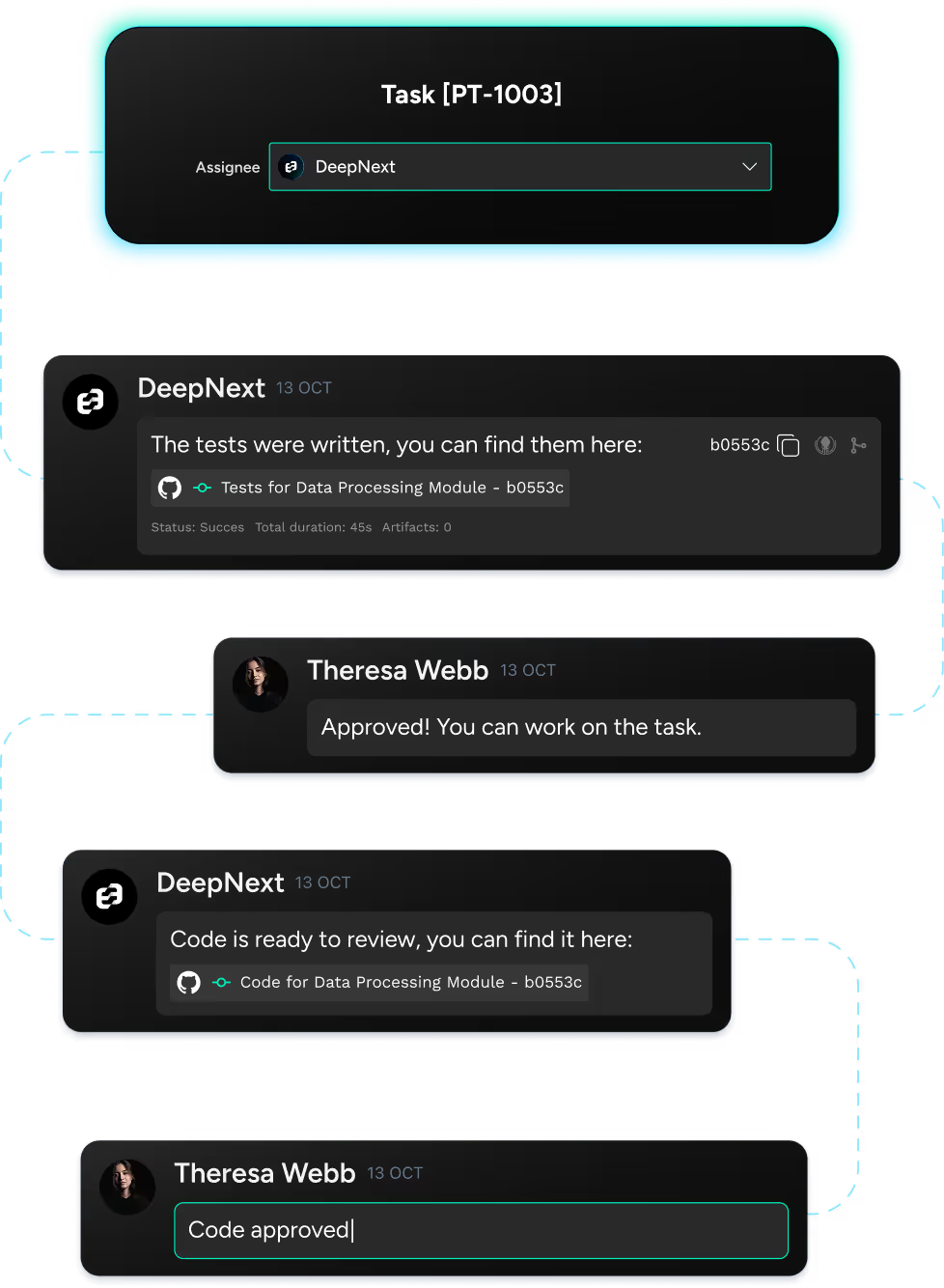
DeepNext Workflow step-by-step
Task Assigned
A developer labels a GitHub/GitLab issue or assigns DeepNext directly.
Project Onboarding
DeepNext analyzes the whole repository in 3–5 minutes.
Knowledge Gathering
Agents read:
file structures
class definitions
dependencies
documentation
architectural patterns
Solution Architecture
DeepNext drafts an initial solution idea, then refines it via multiple agent iterations.
Action Plan Creation
An AI agent generates a detailed action plan, which a software engineer can accept or modify when working in human-in-the-loop mode.
Implementation
DeepNext writes code respecting:
project structure
coding patterns
best practices
maintainability guidelines
Code Review
After the implementation, DeepNext inspects its output:
detects silent bugs
runs tests
checks for inconsistencies
Pull Request Created
DeepNext produces a ready-to-merge PR with a full diff and updated documentation. Then, a senior engineer makes the final decision on the generated code.
Natalie Williams, COO, Brief Media
How DeepNext influences the software engineering process
Increased Engineering Velocity
DeepNext accelerates delivery cycles, enabling teams to complete small and medium tasks in a matter of minutes.
Cost Reduction
by automating lower-complexity tasks, teams can save up to 40% of development costs.
Reduced Cognitive Load
engineers can offload repo exploration, repetitive fixes, boilerplate coding, and documentation updates to focus on more complex tasks.
Improved Developer Experience
DeepNext keeps senior engineers in control while automating execution. They can work with the tool the same way they work with teammates – through tickets, comments, and reviews.

Would you like to use AI to optimize your internal and external operations?
Schedule a meeting with our experts and let's create a tailor-made AI-powered solution for your business.
Our customers love to work with us


ul. Mostowa 38
61-854 Poznań
Poland
C.11 310 Col. Santa Gertrudis Copo
Merida, 97305
Mexico
10 York Rd
London SE1 7ND
United Kingdom
c/o Rödl RAe, Taunus Tower, Mergenthalerallee 73-75
65760 Eschborn
Germany
City Place 1401 Lake Plaza Dr, Ste. 200
Spring, TX 77389
United States