
Enterprise AI for Oil & Gas
Turning Raw Telemetry into Operational Margin
Energy never sleeps, and neither do we. STX Next adds task-focused, rules-based AI agents and relevant data products to your setup.








Our services
STX Next builds modern, secure data foundations tailored to your environment. Our solutions ensure trust, visibility, and scalability across predictive maintenance and compliance reporting.
Data Mesh & Lakehouse Engineering
Modern, domain-aligned data infrastructure built on AWS, Azure, Snowflake, or Databricks. We replace rigid, bottlenecked central data pipelines with decentralized "data products" where individual operational domains own their data lifecycles, schemas, and quality SLAs.
Production & Field AI Agents
Deploying localized, task-scoped industrial intelligence directly to the plant floor and field crews. This includes Root Cause Engines that cross-reference SCADA telemetry with shift logs, and secure, offline-capable mobile Field Service Assistants that instantly parse technical documentation and fleet manuals.
Soft Sensor Engineering (Virtual Telemetry)
Leveraging machine learning models to estimate critical, hard-to-measure variables (such as composition, wear states, or internal temperatures) from your existing network of easy-to-measure sensors. Our lab-validated, calibration-free virtual sensors function reliably where hardware sensors drift or fail in hostile environments.
RAG Knowledge Automation Systems
Secure Retrieval-Augmented Generation (RAG) systems that ingest large volumes of technical documentation – manuals, safety PDFs, procedures – and return accurate, cited answers instantly. These knowledge assistants reduce search time and support safer, faster operational decisions.
Predictive Maintenance & Asset Reliability
Transitioning critical assets from rigid, calendar-based schedules to condition-based maintenance. By training explainable models on historical process telemetry, vibration data, and failure logs, we accurately predict the remaining useful life (RUL) of your rotating fleet, compressors, and furnaces to cut unplanned downtime by up to 20-30%.
Back-Office & Financial Operations Automation
Targeted multi-agent orchestrations designed to handle high-volume, rules-based digital workloads up to 10x faster. We build secure, sovereign AI agents using your existing automation stack (n8n, Copilot Studio, Claude) to accelerate supplier releases, ERP reconciliations, compliance reporting, and KYC processing.
Cross-Functional Systems of Intelligence
Connecting active field diagnostics and corporate execution layer systems. When a field asset flags a failure risk, the System of Intelligence autonomously initiates the multi-department response: checking technician schedules, mapping parts SKUs, routing procurement POs, and flagging required executive approval tiers.
Industrial AI Training & Enablement
Structured, hands-on capability development to drive true internal organizational adoption. We provide a 20-hour Technical Workshop for engineers focusing on secure integration patterns and quality-first coding with LLMs, alongside a 16-hour Non-Technical Workshop tailored for operations, finance, and procurement professionals using low-code automation tools.
Field-Tested AI Use Cases for the Oil & Gas Industry
Root Cause Agent / Diagnostic Engine
Speeding up incident analysis from hours to minutes by automatically linking SCADA telemetry with shift logs.
Your SCADA and historian infrastructure, shift logs, maintenance records, and existing SOPs/P&IDs.
An agent that combines different data streams. It provides a ranked list of likely anomaly causes and a clear, auditable evidence trail.
Precision diagnostics down to minutes, capturing senior-level reasoning as an organizational asset so junior operators excel on day one.
Process Advisor Agent
An always-on advisor monitors live variables and suggests adjustments for better performance while ensuring safety.
Process historians, defined safe operating envelopes, energy metering, and alarm history logs.
A real-time advisor, either closed-loop or human-in-the-loop. It logs every setpoint recommendation and explains the reasons behind each one
Drastically lower energy costs per unit while keeping human operators firmly in control with fully auditable, calibration-free logic.
Asset Reliability & Predictive Maintenance Engine
Predicting Remaining Useful Life (RUL) enables flexible, condition-based maintenance.
Active site sensors (vibration, temperature, pressure), operational historians (like OSI Pi), historical failure logs, and your existing CMMS/EAM systems.
Explainable machine learning models that analyze real-time telemetry with historical patterns. They help detect early-stage degradation anomalies before a standard SCADA alarm triggers.
Reduction in unplanned downtime and extended equipment lifespan. This helps you service key assets like compressors and furnaces when needed, cutting down on extra maintenance costs.
Back-Office Automation Agents
Multi-agent orchestrations designed to handle rules-based administrative workloads up to 10x faster.
Core ERPs, CRMs, document repositories, and highly repetitive manual workflows.
Task-scoped, rules-based agents that execute digital workflows and maintain a comprehensive, 100% transparent audit log.
Reclaimed engineering and admin hours. This lets your operations grow easily without needing more staff.
Mobile Field Service Assistant
Provide field technicians with an offline knowledge agent for local documentation and safety protocols.
Standard field smartphones, vendor manuals, asset registries, and regional service histories.
An offline-ready assistant that allows technicians to snap a photo of an asset or ask a question in natural language to extract instant answers.
Improved first-time-fix rates and reduced asset downtime. Field insights sync automatically to enhance global fleet history.
Cross-Functional System of Intelligence
Moving away from passive dashboard monitoring into automated, proactive operational intelligence.
Customer master data, historical asset telemetry, CRM entries, and dispatch systems.
A system that catches consumption anomalies or failure risks early and automatically triggers the underlying workflow across siloed systems.
A seamless solution from start to finish. It automatically schedules the right technician, identifies SKUs, routes procurement POs, and closes the loop.


Tech Stack and Partnerships for Unique Challenges
From dynamic scaling requirements and real-time data processing to compliance and regulatory alignment, we've got you covered.









Challenges we can help you with
The biggest barrier in Oil & Gas isn’t in the field. It’s in the disconnected systems and tribal knowledge behind it.
Our Philosophy: Pragmatism Over Hype
We don’t pitch generic, one-size-fits-all Machine Learning models. We isolate specific, high-impact opportunities where condition-based intelligence yields a measurable operational difference, then scale systematically from there.

(Ex-GE Aviation Thermal Systems, Ex-Schneider Electric)
Retiring Expertise
The most expensive consultant is the senior operator walking out the door. When veteran engineers retire, their undocumented expertise goes with them. Without a mechanism to capture this knowledge, the next generation is forced to rebuild it from scratch.
- Autonomous Root Cause Agents combine live SCADA data with shift logs and maintenance notes. This brings senior-level diagnostic insights to junior operators.
- Human-in-the-loop validation loops take live engineering diagnostics and put them directly into the software. This turns human expertise into a valuable, searchable asset for the organization.
- Offline-capable Mobile Field Assistants empower remote technicians with access to global vendor manuals, SOPs, and site service histories so that field intelligence never retires with people.
Data fragmented into silos
Key operational insights are stuck in old historians, unindexed PDFs, and handwritten shift logs. They are isolated from modern analytics. Engineers spend hours fixing duplicated or error-prone spreadsheets, and you cannot train a model on data no one trusts.
- Cloud-native lakehouse platforms unify data into a single source of truth.
- Built-in quality checks and standardized schemas for clean, consistent data without manual cleanup.
- Pre-configured building blocks for ingestion, modeling, and dashboards deliver quick wins and ROI.
- Advanced reporting, live dashboards, and AI-ready pipelines, turning raw industrial data into predictive insights and automation.
Missing data foundations
Chasing AI ROI on unscaled infrastructure is a costly gamble. When upstream data foundations are messy, telemetry volumes become unusable, trapping engineers in manual work. Traditional automation struggles with unstructured logs and PDFs. This limits effective predictive maintenance and raises your operational costs.
- Natural language interfaces allow engineers and managers to ask questions directly of their data and get accurate, cited answers instantly.
- Autonomous AI agents read maintenance logs, cross-check against sensor data, trigger work orders, and update SAP, handling end-to-end workflows without manual intervention.
- Smarter operations reduce downtime, speed up compliance reporting, unlock knowledge buried in endless files, and free engineers from repetitive data tasks.
Legacy software
Outdated ecosystems that are closely linked turn minor software updates into costly operational crises. High licensing fees tie you to strict vendor technology. This slows innovation and raises costs. Older software lacks the resilience and data security needed for today’s cybersecurity threats.
- The modern integration layer allows changes while avoiding operational disruption.
- By replacing proprietary connectors with open standards, we cut license costs and accelerate new initiatives.
- Data and application migration to Microsoft Azure, leveraging services such as Data Factory, Synapse, Fabric, and Databricks for scalable processing, analytics, and AI.
- The result: a secure, future-ready software environment with no weak spots left to exploit.
Two Paths, One Foundation
AI adoption in oil & gas is not a single project, but a sequence. Each layer is built on what is already working and depends on it. STX Next works across every tier of this model, starting where your data is today.
Our starting point is always what you already have, not what a generic AI roadmap assumes you should have.
The Actual Foundation
Before any AI project starts, the data pipeline needs to be in place. Sensors, historian systems, network connectivity, and a place to store and process operational data. Without this, everything above produces unreliable outputs.
Soft Sensors · AI Field Service · Root Cause Agent
First wave of AI agents and virtual sensors supporting engineers directly on the asset.
Automation Stack · Back-Office Agents
Roll out LLM-based agents for finance, procurement, and HR operations on top of your existing automation toolchain.
Predictive Maintenance
Continuously analyzing real-time telemetry against historical patterns to detect early-stage degradation long before alarms trip.
Finance & Procurement Automation
Multi-agent orchestrations handling rules-based administrative workloads up to 10x faster across ERPs, CRMs and document repositories.
System of Intelligence
A dashboard tells you what happened. An intelligence system tells you what to do before it does. Once both tracks are running, they can be connected into a cross-functional system that makes decisions across operations and back-office, not just within one department.
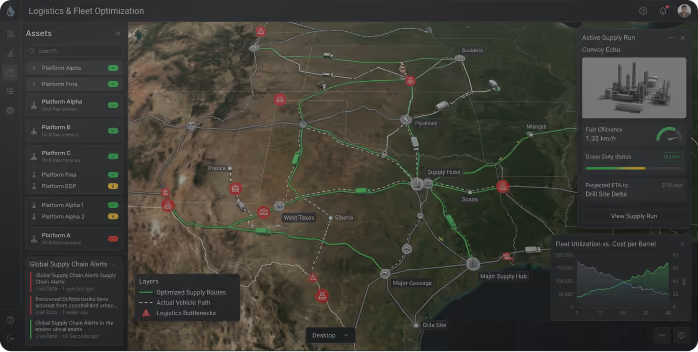
Continuous capability building
AI-Augmented SDLC & Operations Automation · Tech Bootcamp + Business Enablement · Adoption built into every engagement.
Data Mesh & Lakehouse Integration
Stop letting centralized data become your primary operational bottleneck. We modernize your environment by implementing domain-aligned data products that grant teams full lifecycle ownership of their schemas and quality SLAs.

Validated Results with Global Industrial Leaders
Our teams help global corporations adopt AI solutions responsibly, securely, and cost-effectively. How do we do it? Let our work speak for itself.
Chemical Industry Enterprise: a 20% reduction in unplanned downtime with Predictive Maintenance
The Challenge: Legacy data transformation tools failed to process high-volume real-time telemetry from production sites, while rigid calendar-based maintenance schedules drove up costs across 72 olefin furnaces.
The Solution: STX Next engineered a scalable platform utilizing Azure Data Explorer and a two-stage Machine Learning framework (classification + regression) paired with digital twins and SHAP-driven explainability.
The Metrics:
- Successfully ingests and processes 100 million telemetry records per day across 11 factories.
- Delivered a 20% reduction in unplanned downtime across production sites.
- Processed over 600 million historical sensor data points down to clean, hourly resolutions.
Chemical & Industrial Manufacturing
Chemical Industry

Linde: Multilingual RAG Knowledge Automation
The Challenge: Global teams spent hours manually searching through thousands of disconnected regulatory and corporate policy PDFs across multiple countries.
The Solution: Built a secure, Azure-hosted Retrieval-Augmented Generation (RAG) system that automatically maintains its index and provides verified, source-cited answers.
The Metrics: Compressed manual search timelines from hours to seconds across 50 countries while maintaining strict data sovereignty.
Making a difference
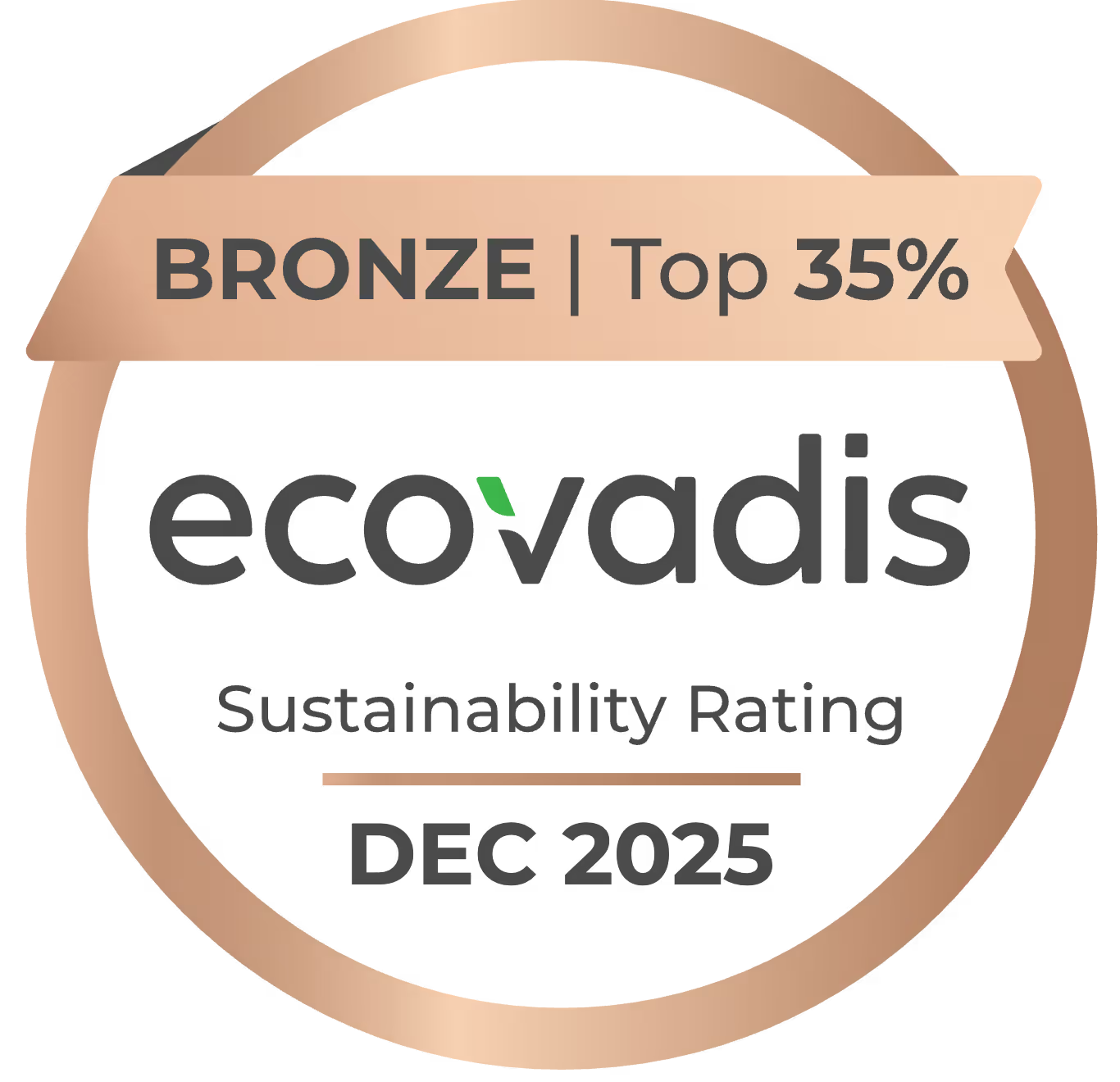
The success of our clients and co-workers depends on smooth processes and informed decision-making. We hold the EcoVadis Bronze Medal, placing us in the top 35% of sustainable companies globally.
It validates our commitment to green energy and responsible operations.
Ready to transform your Oil & Gas enterprise?
Let’s discuss your current data infrastructure, site historians, and high-impact automation targets. Speak directly with an STX Next industrial technology specialist.



FAQs
We rely heavily on legacy historians and on-premise SCADA. Do we need a complete cloud migration to start using AI?
No. While we specialize in cloud modernization (AWS, Azure, Snowflake, and Databricks), we explicitly support on-premise and edge deployments that bypass the cloud entirely. We build integration layers over your existing Purdue Model architectures and site historians (like OSI Pi) so you can deploy industrial intelligence without disrupting stable control-room networks.
How do you protect against AI "hallucinations" in high-risk plant environments?
We don't deploy unmonitored "black-box" systems on the plant floor. Our Process Advisor and Root Cause Agents operate strictly within your pre-defined safe envelopes and utilize Explainable AI (via SHAP values). Every single recommendation is logged with a visible, clear evidence trail detailing why an action was proposed, keeping your human operators firmly in control.
Our data is siloed across multiple facilities, and a centralized data team is already a bottleneck. How do you handle this?
We tackle this structural barrier by introducing a Data Mesh architecture. Instead of forcing a single central team to manage a massive data dump, we pivot to domain-aligned data products. Each operational unit owns the lifecycle, documentation, schemas, and quality SLAs of its own data. This eliminates pipeline queues, ensures reliable data ingestion, and makes your telemetry instantly usable for site engineers.
We handle highly sensitive infrastructure, compliance, and asset data. How do you guarantee data sovereignty?
We guarantee 100% data sovereignty. Our solution blueprints are built to run within your own enterprise environments. Whether implementing secure, isolated Azure-hosted RAG networks to parse policy PDFs or deploying enterprise self-hosted automation platforms (such as self-hosted n8n), your proprietary operational data never trains external vendor models.
How do you ensure our field crews and plant operators will actually adopt these tools?
We don't drop technology off at the door; we build organizational adoption directly into our deployment roadmap. In parallel with software integration, we run two dedicated enablement tracks: a 20-hour Technical Bootcamp to teach your engineers quality-first development with LLMs, and a 16-hour Business Track to show operations and finance teams how to build localized, low-code automations independently.


