
AI Workshops, Trainings, and Enablement
The AI Excellence Program: The Dual Training Path to AI Maturity
You can't just buy AI licenses and build solutions then expect ROI from AI initiatives without triaining and enabling your teams on how to effectively use and integrate these solutions first.
STX Next’s AI Excellence Program is built around two training paths for technical and non-technical roles, so your organization moves from experimentation to maturity with clarity and depth.


Gemini

GPT

Copilot Studio

n8n

Power Automate

Claude

Copilot

Cursor
Two dedicated training paths
Same ambition, different depth. Technical teams go deep on SDLC, code, and secure integration. Business teams master prompts, assistants, and agentic workflows with no/low-code interfaces.
For software developers
Engineers, architects, DevOps: The AI Bootcamp
- AI across the SDLC & security guardrails
- Quality-first coding with LLMs & tooling
- Advanced integration & architecture patterns
For operations and business
PMs, analysts, ops, HR, marketing: AI Enablement for Business
- Precision prompting, RAG, and grounded use
- Task-specific assistants (e.g. Copilot Studio)
- Agents & automation (Power Automate, n8n)
Prompt Engineering
Context, roles, patterns, and grounded prompts that hold up at work.
Assistants
Task-specific copilots and assistants tuned to your workflows.
Agents
Multi-step agent flows, tools, hand-offs, and guardrails.
Automation
Connecting systems with automation (e.g. Power Automate, n8n).
Augmented Coding
LLM-assisted SDLC: design, implementation, review, tests, security.
Bespoke / tailored programs
Alongside the two defined paths, we design custom engagements around your organization’s reality: goals, toolchain, and governance, not a one-size-fits-all slide deck.
Duration & suggested cadence
Each path has a clear time box so you can plan calendars and minimize disruption. Exact slots are agreed with your executive team, managers, or L&D team.
The AI Bootcamp: SDLC, secure integration, quality-first coding, and advanced tooling.
- 4 days × 5 hours per day or
- 5 days × 4 hours per day
AI Enablement Masterclass for Business: prompting, assistants, and agentic workflows for business roles.
- 3 days × ~5 hours per day, or
- 4 days × ~4 hours per day
“Plug & play” learning
Learning by doing. We handle the heavy lifting.
Participants only need a browser. Roughly 80% of the time is about building hands-on; no death by PowerPoint, guaranteed. After the workshop, teams keep templates and sources for every agent and assistant created in-session.
Full infrastructure
Accounts, models, and tokens so you can focus on outcomes, not setup.
Hands-on labs
Real workflows, not slide-only sessions.
Asset library
Reusable templates and sources to deploy immediately.
- Accelerated digitalization: assistants become durable internal assets.
- Lower operational cost: automate repetition; free time for strategy.
- Risk mitigation: safer AI practices for data and reliable outputs.
- Sustainable transfer: optional post-workshop hours with our experts.
What you will achieve
By the end of this program, your organization moves from AI consumers to AI Architects and an AI-augmented Workforce.
For engineers
Standardize AI across the SDLC for higher-quality code and faster delivery, without compromising security.
For business professionals
Master autonomous agents and prompting. Delegate complex work to “virtual employees.”
For the organization
Build a “Virtual Agentic Platform,” a library of internal agents that drives continuous digitalization.
For independence
Own the skills to build and maintain these systems, with less long-term vendor lock-in.

How EV Financial Solutions Transformed Development with the STX Next AI Bootcamp

Training agendas
Condensed outlines for both paths. These can be customized to your needs.
The AI Bootcamp
Short demos plus real implementation work, aligned with our public STX Next AI Bootcamp.
- Day 1. Project planning, context engineering, prompts, environment and tooling, UI exploration.
- Day 2. Backend: scaffolding, services, REST API, tests, debugging.
- Day 3. Frontend: UI, API integration, forms and validation, automated testing.
- Day 4. Catch-up, optional LLM tooling topics, summary and feedback.
- Q&A. Applying the workflow to your own projects.
AI Enablement Masterclass for Business
For roles that do not ship code: grounded prompting, task assistants, lightweight agents, and automation using tools your organization already licenses.
- Block 1. How LLMs work in practice: limits, parameters, and realistic expectations.
- Block 2. Better prompts: context, roles, and removing ambiguity.
- Block 3. Reusable patterns: structure, examples, step-by-step reasoning when it helps.
- Block 4. Safer outputs: guardrails, grounding, and controlled formats.
- Block 5. Operations: working with documents, assistants, and security-minded habits in the enterprise.
- Block 6. Building AI agents: defining goals, tools, and hand-offs; prototyping multi-step flows in low-code platforms (e.g. Copilot Studio, Power Automate, n8n) without writing application code.
Challenges we address
From fragmented adoption to production maturity: technology, process, and people in sync.
Fragmented AI adoption
- Inconsistent tools and practices
- Experiments without reusable assets
- Gap between business and engineering
- Parallel technical & business tracks
- Shared patterns across SDLC and ops
- Path to a Virtual Agentic Platform
Security & reliability
- Shadow AI and ungoverned models
- Data-handling uncertainty
- Low trust in critical decisions
- Secure SDLC patterns (Track 1)
- RAG & responsible prompting (Track 2)
- Enterprise workflows (n8n, Power Automate)
Operational drag
- Manual, repetitive work
- Document and comms overload
- Skills siloed in a few people
- Build assistants & agents in-session
- Templates and source assets to reuse
- Optional expert hours after delivery
Vendor dependency
- External teams for every iteration
- Unclear ownership of AI systems
- Slow idea-to-production cycles
- Skills transfer as a core outcome
- Full training environment included
- Your teams extend what they build

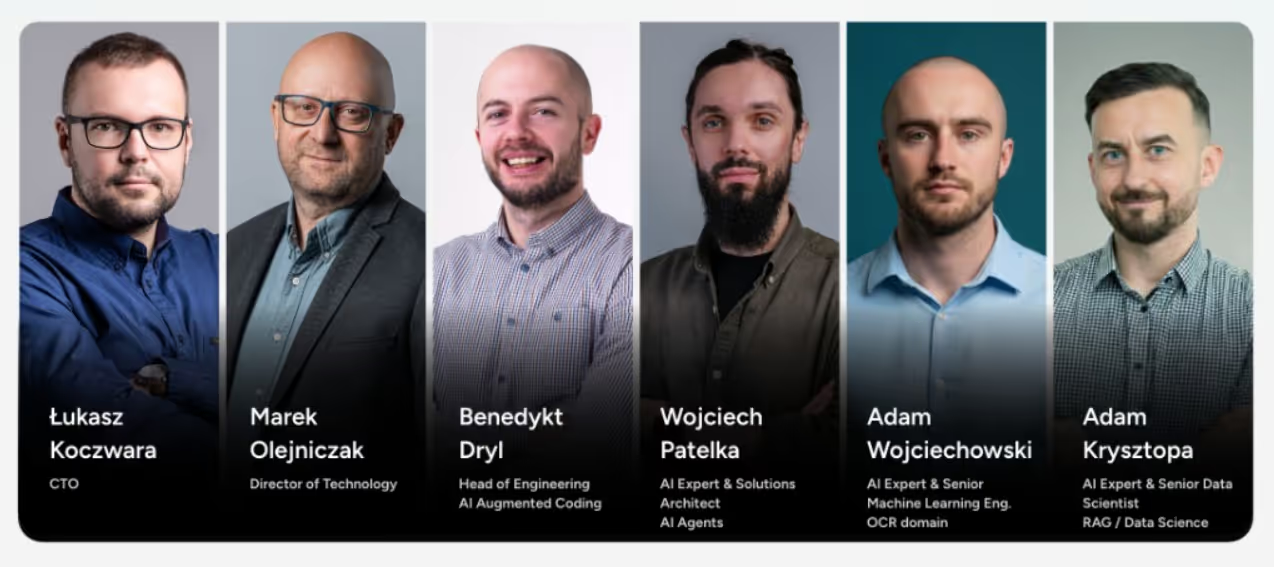
Trainers behind the program
Practitioners from our CTO office, technology leadership, and specialist AI engineering: the same people who ship AI in client delivery, not slide-only facilitators.
Partners & ecosystem
Cloud, data, and automation platforms we work with to modernize delivery.
AWS

Snowflake

Azure

CloudFerro

n8n

Squirro

Stackit
Client
testimonial

We’re able to now use AI in a much more practical way as part of our day to day tasks. I think prior to the Bootcamp, all the developers used AI in a very small way (...). I think they [STX Next] are really ahead of the curve when it comes to AI, how to best use it and how to implement it in everyday life, not just for the gimmicky tasks. So the expertise was perfect for what we got out of it.

EV Financial Solutions
Let's talk
Schedule a chat with our AI Director and one of our engineers to discuss your training needs.


FAQ
Who should attend each track?
The Technical Track fits software engineers, architects, and DevOps engineers.
The Non-Technical Track fits PMs, analysts, operations, HR, and marketing: anyone owning prompts, assistants, and workflow automation without shipping app code.
What do participants need on their laptops?
Only a web browser. STX Next provides accounts, models, and tokens so teams can focus on building.
If you have your own setup and preferences, we can use that instead.
How much is hands-on?
About 80% labs and building; the rest frames context, patterns, and governance for repeatable outcomes.
We're not aiming to teach only theory.
What do teams take away?
An asset library: templates and sources for every assistant and agent built in the workshop.
Security and data handling?
Safe AI practices are built in, especially SDLC security in Track 1 and grounding/RAG patterns in Track 2. Controls can align with your organization’s policies during discovery.
Do you offer ongoing support?
Yes. An optional post-workshop support package with a defined number of expert hours for real-world rollouts.


