



Industrial data is complex by design
In manufacturing, data is messy by nature. Machine firmware updates introduce new fields without warning. Sensor payloads change format between production batches. MES systems retroactively correct scrap rates or shift allocations. Edge devices resend buffered telemetry hours later. Meanwhile, ERP data remains strictly transactional and expects consistency.
Individually, none of these behaviors is unusual. Together, they create architectural tension.
.png)
The real engineering challenges in manufacturing
The complexity of industrial data surfaces in a few recurring patterns we see across projects:
Schema evolution under continuous change
In manufacturing, schema changes have operational side effects: new sensors are added, quality attributes expand, and payloads shift after firmware updates. If every structural change requires rewriting large datasets, the platform will not scale.
Late-arriving and corrected data
Industrial systems frequently rewrite the past. Buffered edge data arrives out of order and MES corrections modify historical production records. Without proper merge semantics and snapshot isolation, analytics quickly diverges from operational truth.
Incremental processing at scale
Reprocessing entire datasets is not viable when telemetry volumes reach billions of records. Incremental writes, compaction strategies, and controlled metadata growth become mandatory.
Auditability and reproducibility
Root cause analysis and product genealogy require reconstructing the exact state of data at a specific point in time. “Eventually consistent” is not enough.
Metadata explosion
High-frequency sensor data inevitably leads to millions of small files. Without deliberate table-level management, query planning degrades long before storage becomes a problem.
At this point, the architectural gap becomes clear: A traditional data lake offers flexibility but weak consistency. A traditional warehouse offers consistency but limited adaptability. And manufacturing requires both, simultaneously.
Reference architecture: How an Iceberg lakehouse works in manufacturing
Apache Iceberg is an open table format that adds transaction-like table semantics, schema evolution, snapshot isolation, and time travel on top of object storage. In manufacturing lakehouses, it helps teams manage late data, corrections, and multi-engine analytics without duplicating datasets.
You can think of an Iceberg-based lakehouse for manufacturing as four layers working together:
- ingestion that assumes data will be late, duplicated, and corrected
- processing that turns raw events into operationally meaningful datasets
- table management that keeps object storage consistent and evolvable at scale
- query and consumption layers that support BI, analytics, and AI without copying data
Here’s a practical reference architecture that maps well to common industrial workloads:
High-level architecture
Sources (IoT / PLC / MES / ERP / QC)
→ Kafka / MQTT / CDC
→ Stream and batch processing (Flink / Spark)
→ Object storage (S3-compatible)
→ Apache Iceberg tables
→ Query engines (Trino / Spark, with ClickHouse optionally used for high-concurrency serving scenarios)
→ BI / ML / AI workloads
None of these components are unusual on their own. What matters is how they behave under industrial conditions.

1. Ingestion layer: design for imperfect streams
Manufacturing ingestion breaks when it assumes that data will be clean, ordered, and complete. In reality, telemetry arrives late, devices reconnect and replay buffered messages, ERP systems emit corrections, and historical gaps still need to be backfilled.
Typical ingestion patterns include:
- Kafka for machine events, telemetry, and PLC state changes
- MQTT for edge and IoT connectivity where instability is expected
- CDC from ERP and MES systems for orders, inventory, BOM, and master data
- batch ingestion for historical loads, reprocessing, and missing partitions
At this stage, the key design decision is not the transport itself, but the ingestion contract.
On one manufacturing platform processing roughly 4 billion sensor events per day, ingestion stability depended less on broker throughput than on discipline around three rules:
- idempotent writes
- explicit duplicate handling
- event-time watermarking
A practical rule is to treat every stream as at-least-once unless production proves otherwise. In real systems, replay storms rarely cause dramatic failures. More often, they quietly duplicate events and distort downstream KPIs.
What looked simple in architecture diagrams became harder once replayed telemetry had to be joined with corrected MES records and then exposed to reporting. The biggest failures usually came not from missing technology, but from misaligned expectations between layers.
That is why ingestion pipelines should define an end-to-end idempotency key, validate replay stability, and monitor duplicate-rate and late-event spikes alongside normal pipeline lag. In industrial settings, getting ingestion “mostly right” is usually not enough. Small inconsistencies at this stage tend to compound downstream.
2. Processing layer: turn raw events into operational truth
Once data enters the platform, the next challenge is not simply transformation, but reconciliation.
Industrial pipelines need to normalize telemetry, remove duplicates, enrich events with operational context, and incorporate corrections without constantly rebuilding large datasets. This is where Spark and Flink usually carry most of the platform logic.
Common patterns include:
- streaming upserts for corrected MES records and late telemetry
- controlled micro-batching to avoid unstable commit behavior
- deduplication based on event keys or sequence numbers
- operational aggregations at machine, shift, batch, or work-center level
A typical flow looks like this:
Sensor stream
→ normalize and validate
→ deduplicate
→ enrich with MES context
→ write to Iceberg bronze and silver tables
→ run scheduled compaction
One hard-earned lesson is that business logic should not live in dashboards. If a transformation affects production reporting, quality metrics, or ML features, it belongs in a reproducible pipeline that writes a stable table.
In practice, the hardest part was rarely the stream itself. It was joining late telemetry with changing MES context without making KPI logic drift between pipelines, dashboards, and ad hoc analysis. In industrial environments, semantic drift is often more dangerous than schema drift. Once teams start calculating the same operational metric in multiple places, trust erodes quickly.
That is why processing pipelines should be treated as the place where operational truth is assembled, not just where data is moved.
A common industrial upsert pattern
In many manufacturing workloads, append-only processing is not enough. Late telemetry, MES corrections, and changing production context require row-level updates rather than simple inserts.
A common pattern looks like this:
Sensor events
→ land in a staging table
→ deduplicate based on event_id + machine_id + event_time
→ enrich with MES context
→ MERGE INTO a curated Iceberg table keyed by business identifiers
→ run scheduled compaction to optimize file layout
With Iceberg, this allows teams to correct historical records without rewriting the full dataset, though affected files still need to be rewritten by the engine. In practice, this is often the difference between a platform that models industrial corrections cleanly and one that pushes reconciliation downstream.
3. Table layer: make object storage behave like a governed data system
This is where Apache Iceberg becomes central.
It is important to distinguish that Iceberg defines table behavior, not execution - actual capabilities still depend on the engines interacting with those tables.
Object storage on its own gives scalability, but not dependable table behavior. Iceberg adds the table layer needed to manage concurrent writes, controlled evolution, and metadata at industrial scale.
But taking a small step back, the table layer is only as reliable as the catalog that coordinates it. Iceberg does not manage tables in isolation - it relies on a catalog (such as REST, AWS Glue, Hive Metastore, or Nessie) to track table state, handle concurrency, and expose metadata consistently across engines. The choice of catalog directly impacts governance, access control, multi-engine interoperability, and even deployment patterns across environments. In industrial platforms, this is not a secondary concern. A poorly chosen or inconsistently configured catalog becomes a bottleneck for evolution and cross-team collaboration, while a well-designed one enables controlled changes, clear ownership, and predictable behavior across ingestion, processing, and consumption layers. Last but not least, the catalog effectively becomes the control plane for governance - defining how data is discovered, versioned, secured, and shared across teams and tools.
In practice, three capabilities matter most here.
Consistent table state
Writes become visible only through committed table metadata, which prevents readers from seeing partially written states.
Controlled evolution
Schemas can change without forcing full historical rewrites, which matters when firmware updates or new quality attributes appear midstream.
Metadata discipline
As file counts grow, compaction, retention, and manifest maintenance become operational requirements rather than optional tuning.
For example, on one production system, a firmware update introduced six additional sensor attributes in the middle of a reporting cycle. The technical schema change itself was straightforward. The harder part was validating downstream pipelines and aggregates so that new fields did not introduce silent KPI drift.
This is an important distinction. Iceberg makes schema evolution technically easier, but it does not remove the need for governance. In real industrial platforms, flexibility without ownership quickly becomes instability.
That is why mature teams usually combine Iceberg’s schema evolution support with lightweight contracts, clear table ownership, and stricter change controls in silver and gold layers than in raw ingestion zones. If nobody owns a critical column, nobody notices when its meaning changes.
Partitioning also needs to be treated as a long-term design choice. In manufacturing, access patterns usually follow event time, line, plant, shift, or batch, not arbitrary ingestion-time layouts. Iceberg’s hidden partitioning helps preserve that flexibility without hard-wiring physical layout assumptions into every downstream query.
We have also seen platforms degrade gradually rather than fail loudly. The issue was not always compute saturation. More often, it was metadata overhead caused by small files, over-frequent commits, or neglected retention. The platform stayed stable only when compaction, retention, and schema control were treated as operating disciplines, not cleanup tasks.
It’s important to highlight that at scale, table maintenance becomes an explicit part of platform engineering rather than a background task. This includes regular snapshot expiration to control metadata growth, data file compaction to address small-file accumulation, manifest optimization to keep query planning efficient, and orphan file cleanup to prevent silent storage bloat. These operations are not optional optimizations - they are required to keep performance predictable as data volume and write frequency increase. In industrial environments, teams that treat maintenance as a scheduled, observable process tend to avoid the gradual degradation that otherwise appears long before any hard system limits are reached.
4. Query and consumption layer: support multiple workloads without copying data
Once data is managed as Iceberg tables, different engines can serve different workloads against the same table layer.
Typical roles are straightforward:
- Trino for interactive and federated SQL
- ClickHouse for high-concurrency analytical serving
- Spark for large-scale feature engineering and ML pipelines
The architectural benefit is not simply engine choice. It is the ability to support BI, analytics, and AI from the same governed tables rather than maintaining multiple copies of the same data.
That said, multi-engine access only works well when it is validated deliberately. We have seen teams assume that exposing the same Iceberg table to multiple engines automatically guarantees consistent results. In reality, timestamp handling, numeric precision, and row-level semantics are often where reconciliation breaks first.
In practice, teams should test critical KPI queries across engines, verify timestamp behavior carefully, and confirm how row-level operations behave when upserts or deletes are part of the pipeline design. These checks are usually lightweight early in a project, but expensive to postpone.
Even with technically consistent tables, business consistency still requires one more layer: shared metric definitions. Manufacturing KPIs such as OEE, scrap rate, downtime, or yield often diverge not because data is missing, but because different teams calculate them differently. Centralizing data does not automatically centralize meaning.
A semantic layer or metrics framework is what turns shared data into shared business logic. Without it, the same Iceberg tables can still produce conflicting answers, especially once BI tools, plant reporting, and AI workflows all consume the same datasets in parallel.
What makes this architecture production-ready
A manufacturing lakehouse is not production-ready just because the stack is modern.
What makes it robust is the combination of:
- ingestion contracts that assume imperfect data
- processing pipelines that absorb corrections and enrich events with context
- a governed table layer that supports evolution and metadata control
- consumption patterns that keep engines flexible but KPI definitions stable
That is the point where an Iceberg-based lakehouse stops being a collection of tools and starts behaving like an operational data platform.
And in our experience, that is usually the real dividing line between a platform that looks good in a reference diagram and one that remains trustworthy under production pressure.
Why the lakehouse model fits industrial platforms
A traditional data lake gives industrial platforms flexibility, but not enough control. It can absorb large volumes of heterogeneous data, yet it does not solve the harder problem: keeping analytics, reporting, and downstream AI consistent when data arrives late, gets corrected, or changes shape over time. In manufacturing, the platform needs a reliable way to manage table state under continuous change.
A warehouse solves the opposite problem. It brings structure, consistency, and governed access, but it is rarely the best foundation for high-volume telemetry, evolving payloads, and mixed industrial workloads. Manufacturing platforms need stronger guarantees than a raw lake can provide, but also more adaptability than a warehouse-only model usually allows. The challenge is not choosing between flexibility and control, but in combining both.
The lakehousekeeps object storage as the scalable foundation, while adding the table semantics needed to manage corrections, schema change, concurrency, and reproducibility more reliably.
For industrial platforms, that combination matters more than architectural elegance. It allows the data layer to stay usable as operational reality keeps changing, which is exactly where Apache Iceberg becomes relevant.
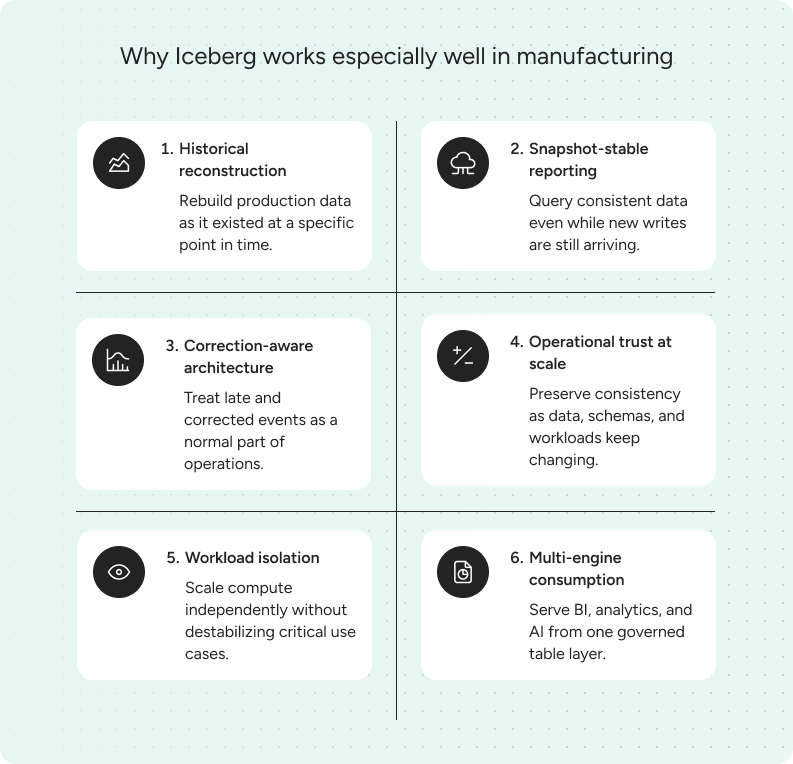
Why Iceberg works especially well in manufacturing
Apache Iceberg is particularly well suited to manufacturing lakehouses because it helps teams:
- handle late-arriving and corrected industrial data without rebuilding full datasets
- maintain consistent reporting and analytics under concurrent writes
- evolve schemas safely as machines, sensors, and quality attributes change
- reconstruct historical table states for root cause analysis, genealogy, and compliance
- support BI, analytics, and AI workloads from the same governed table layer
What makes Apache Iceberg especially relevant in manufacturing is not that it introduces an entirely new stack, but that it adds the table semantics where traditional data lakes were missing.
That distinction matters because industrial data platforms are rarely judged by how elegantly they store data. They are judged by whether teams can trust what they see in production reporting, quality investigations, root cause analysis, and AI workflows.
In other words, the question is not simply whether the platform can hold industrial data at scale. It is whether it can represent changing operational reality without creating silent inconsistency.
Reconstructing what actually happened
Manufacturing organizations regularly need to answer a deceptively simple question: what exactly happened at that moment?
A defect appears. A batch fails quality control. Scrap increases unexpectedly. A customer complaint triggers an investigation. In these situations, the challenge is rarely the absence of data. The challenge is reconstructing the state of the data as it existed at the time, not after later corrections, reprocessing, or metric logic changes.
This is where table versioning becomes strategically important. Eventually consistent history is not enough when teams need to explain what was known at a specific production moment.
Iceberg is particularly useful here because it makes historical reconstruction far more reliable at the table layer. That matters for genealogy, compliance, root cause analysis, and any operational process where “what we knew then” is more important than “what we see now.”
In practical terms, you can reconstruct the state of production data as it existed at the end of shift B on Tuesday, not as it looks after subsequent corrections.
And importantly, this capability doesn’t require duplicating datasets or building parallel audit tables. It is inherent to how Iceberg manages table metadata. That said, it’s important to note that time travel only works as long as the relevant snapshots are retained. Iceberg explicitly recommends expiring old snapshots to control metadata growth, so historical reproducibility should be treated as part of a carefully designed retention policy.
Preventing silent reporting drift under concurrency
Industrial data never really stops moving. Streaming jobs continue to ingest telemetry, MES systems correct historical records, and backfills or late events keep updating the same datasets that reporting depends on.
Without proper isolation, this leads to subtle but dangerous issues: reports calculated on partially updated data, dashboards that change retroactively without explanation, machine-level KPIs that do not reconcile with shift-level aggregates, and ML teams training on unstable datasets.
We have seen this firsthand on an industrial platform where daily production reports were recalculated every morning at 6:00 AM, while late telemetry buffered overnight was still being ingested into the same tables. Nothing failed visibly, but the numbers in the 6:00 AM report did not match the numbers in the 9:00 AM report for the same production day.
The root cause was not faulty reporting logic. It was the lack of snapshot isolation at the table layer. Reports were reading tables while ingestion jobs were still merging late events.
This is a table semantics problem, not just a pipeline problem. It is also the kind of issue that quietly erodes trust in a data platform long before anyone opens a technical incident.
Iceberg addresses this by providing snapshot isolation at the table layer. Readers query a consistent snapshot even while writers continue to commit new data, which is exactly what keeps reporting, analytics, and model training from drifting under concurrent workloads.
Treating corrections as part of the operating model
Manufacturing data is not clean append-only history. It is continuously clarified.
Late telemetry arrives after connectivity interruptions. MES records are corrected. Scrap gets reclassified. Batch context changes. Production events are revised once the real operational picture becomes clear.
In simpler analytical environments, these may look like exceptions. In industrial platforms, they are normal operating conditions.
That is why controlled merge behavior matters so much. The goal is not just to ingest new data, but to represent operational truth as it evolves. Iceberg fits manufacturing particularly well because it supports a model in which corrections can be handled as part of the architecture rather than pushed into brittle downstream reconciliation.
If the table layer cannot absorb corrections cleanly, teams usually end up building fragile workarounds that slowly break trust in the data. This is one of the biggest practical differences between platforms that appear to work in demos and platforms that remain coherent under production pressure.
Preserving control as the platform and workloads scale
As industrial platforms grow, the challenge is not only managing data volume, but maintaining control while both the data model and the workload mix keep evolving.
Manufacturing platforms rarely support just one type of workload. In parallel, they usually run streaming ingestion, batch transformations, interactive analytics, high-concurrency dashboards, and ML feature engineering. Over time, more plants, more lines, more sensors, and more consumers only make that mix harder to manage.
Without a clear separation between storage and compute, the platform becomes fragile. A heavy backfill can interfere with operational reporting. Dashboard concurrency can compete with analytical workloads. Model training can consume resources needed elsewhere. In industrial environments, that is not just an efficiency problem, but an operational risk.
An Iceberg-based lakehouse leans into a different model: object storage as the durable system of record, with compute engines scaled independently for different workloads.
In practice, this model changes three things:
- Right-size compute per workload: Run Flink/Spark streaming continuously, scale Trino for business hours, and spin up Spark clusters for nightly feature generation.
- Isolate workloads instead of fighting resource contention: BI dashboards don’t have to compete with batch backfills. Model training doesn’t slow down operational reporting.
- Freedom to swap or add engines: If a team needs low-latency OLAP, you can add ClickHouse. If analysts need federated SQL, Trino fits. If your pipelines are Spark-based today, you’re not locked into that forever, the table layer stays consistent.
This separation is not just “cloud economics.” In industrial environments, it’s an operational safeguard. When production monitoring depends on timely data, you don’t want a single runaway batch job to become a plant-level incident.
Iceberg supports this decoupled architecture by providing a consistent table layer across engines, with snapshot-based reads and reliable commits helping ensure that scaling compute does not compromise correctness.
What this architecture changes in practice
Iceberg-based manufacturing lakehouse architecture changes how the platform behaves under production conditions: when late data arrives, when historical records are corrected, when multiple engines query the same datasets, and when AI pipelines depend on stable inputs.
- Reporting can run on consistent snapshots rather than partially updated tables
- Historical production states can be reconstructed more reliably for investigations and audit needs
- Schema changes can be introduced with more control as machines, sensors, and operational processes evolve
- Corrections can be absorbed into the table layer instead of pushed into downstream reconciliation
What not to model in Iceberg
It is important to be explicit about what should not be modeled directly in Iceberg tables. Not every industrial workload benefits from being immediately persisted in the lakehouse. High-frequency telemetry, ultra-low-latency monitoring, or transient stream-state processing are often better handled in dedicated streaming or time-series systems before being curated into Iceberg. Treating Iceberg as the durable system of record rather than the first landing zone for every event helps preserve performance, control storage costs, and keep table structures aligned with analytical access patterns rather than raw ingestion characteristics. In practice, the most stable platforms separate real-time operational processing from analytical persistence, even when both ultimately rely on the same underlying data.
Enabling AI use cases on top of the lakehouse
A modern manufacturing lakehouse is not the end goal, but a prerequisite.
Once you have consistent, snapshot-isolated, schema-evolving tables, industrial AI stops being an experiment and starts becoming operational. Predictive maintenance, anomaly detection, yield optimization, and forecasting all depend on the same thing: data that remains stable enough to train on, rich enough to contextualize, and consistent enough to explain.
Without reliable table semantics, AI pipelines drift and KPIs stop reconciling with operational systems. With Iceberg managing the table layer, the platform can support both analytical exploration and production-grade AI workloads on the same governed foundation.
Technology alone is not enough, of course. The difference between a lakehouse that stores data and one that enables measurable outcomes still comes down to engineering discipline in ingestion, processing, partitioning, and maintenance.
Common Iceberg implementation pitfalls
Apache Iceberg provides strong table semantics, but it does not remove the need for architectural discipline. In manufacturing environments especially, the same failure patterns appear repeatedly.
Partitioning for ingestion, not for access
A common shortcut is to partition data purely by ingestion time. It seems convenient early on, but it usually conflicts with how industrial data is actually queried: by event time, plant, line, shift, or batch.
The result is predictable: inefficient scans, poor pruning, and growing performance problems as the platform expands.
Mature teams treat partitioning as a long-term access design decision, not just an ingestion convenience.
Letting the small file problem become a platform problem
High-frequency telemetry naturally creates many small files. The danger is that this rarely causes an immediate failure. More often, the platform just becomes steadily slower as metadata overhead grows and query planning starts to dominate execution time.
This is one of the most common signs that table maintenance is being treated as cleanup rather than as part of normal operations.
Healthy commit sizing, regular compaction, and retention discipline should be built into the platform from the start.
Treating schema evolution as a technical feature instead of a governance process
Iceberg makes schema evolution easier, but that does not make every schema change safe.
In industrial settings, the bigger risk is often semantic drift rather than structural breakage: fields remain technically valid while their business meaning changes underneath downstream pipelines, KPIs, or models.
That is why schema ownership, change review, and curated-layer controls matter just as much as technical compatibility.
Assuming multi-engine access guarantees consistent results
One of the most common mistakes is to assume that if multiple engines can read the same Iceberg tables, they will automatically produce equivalent answers.
In practice, differences in timestamp handling, row-level operation support, and numerical behavior are often where reconciliation issues begin.
Teams that validate KPI queries across engines early usually avoid weeks of confusion later.
Underestimating metadata growth
At industrial scale, performance issues often come less from raw storage volume than from the accumulation of snapshots, manifests, orphan files, and fragmented layout.
This usually surfaces gradually rather than dramatically. Nothing is obviously broken, but planning slows down, maintenance becomes reactive, and trust in the platform starts to erode.
The lesson is simple: metadata management is not secondary platform hygiene. At scale, it is part of core platform engineering.
The pattern behind these failures
The pattern is consistent across industrial platforms: Iceberg gives teams the right primitives, but it does not remove the need for disciplined operating practices.
That is why successful manufacturing lakehouses are not defined only by their stack. They are defined by how well ingestion, processing, table management, and governance remain aligned under production pressure.
Conclusion: Why Apache Iceberg becomes foundational in manufacturing
By introducing reliable table-level versioning, controlled merge semantics, and scalable metadata management on top of object storage, Iceberg turns object storage into a transactionally consistent table layer for industrial analytics and AI.
This is what enables:
- trustworthy root cause analysis through time travel
- stable production reporting under concurrent writes
- safe handling of late and corrected data
- multi-engine analytics without data duplication
- long-term scalability without constant rewrites
In a manufacturing context, that combination becomes a source of architectural leverage.
Iceberg does not replace sound platform design. But it removes a fundamental structural weakness of traditional data lakes: the lack of reliable, scalable table management.
For organizations building data platforms meant to support production-grade industrial AI, that shift is decisive.
Because at industrial scale, data correctness is operational risk management.
Designing such platforms requires more than choosing the right technologies. It requires aligning ingestion patterns, processing pipelines, table semantics, and operational maintenance into a system that remains stable under real production conditions.
If you're planning a manufacturing lakehouse or modernizing an existing platform, explore our Data Lakehouse Consulting & Development Services to see how we help organizations design scalable lakehouse architectures, migrate legacy platforms, and build AI-ready data foundations.


