



Better data products start before engineering
Traditional BI and data web app discovery often suffers from slow feedback loops and rigid static mockups. AI-powered prototyping changes this by using Large Language Models as interactive sparring partners during early discovery. Data architects can rapidly iterate on data storytelling, generate realistic synthetic datasets, and deploy functional prototypes in hours.
This pre-engineering logic validation ensures that user experience, cognitive load, and visual hierarchy are fully tested before engineering teams write a single line of production code.
Using LLMs as discovery sparring partners allows data teams to test dashboard logic, layout architecture, and user experience with realistic synthetic data long before committing developer resources. This helps bridge the gap between vague business requirements and technical execution, creating a repeatable framework for building user-centric data products.
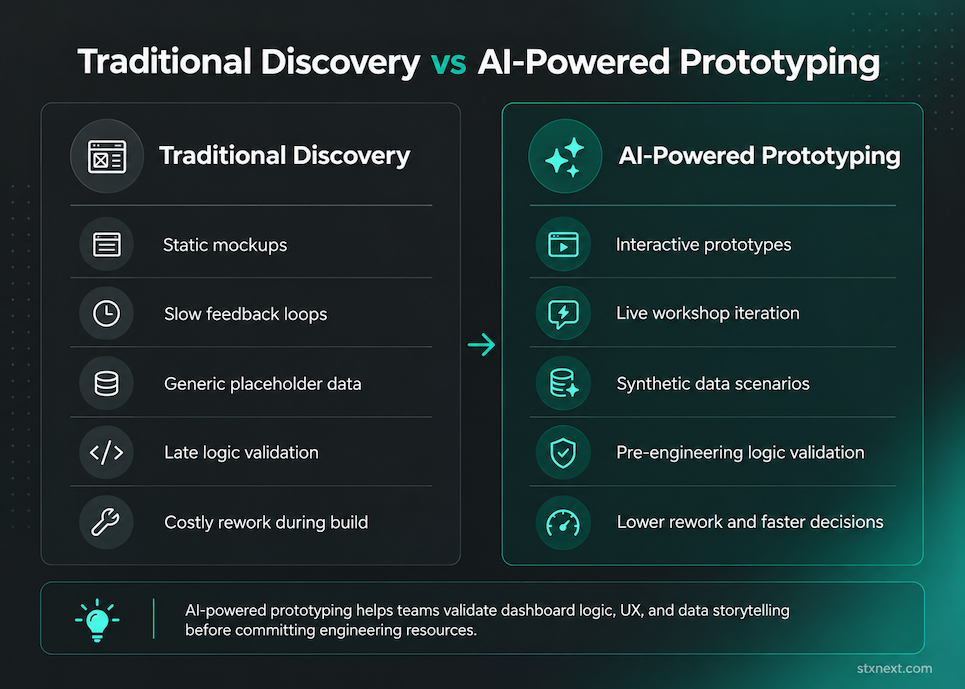
Why traditional dashboard and data product discovery wastes engineering budgets
In most data engineering and business intelligence projects, the transition from business requirements to a fully deployed dashboard design or data-intensive web application is notoriously inefficient.
Organizations typically fall into one of two traps during the discovery phase:
- Building directly in production environments
Teams jump straight into Power BI, Tableau, or custom frontend frameworks using real data pipelines. When stakeholders realize the layout does not answer their core operational questions, re-engineering the underlying queries and visuals consumes weeks of senior developer time. - Relying on static low-fidelity wireframes
Design teams create static Figma mockups filled with generic placeholder numbers or Lorem Ipsum. These static frames fail to simulate real user interaction, variable data density, or edge cases, leaving critical user experience flaws undiscovered until late in the delivery cycle.
The root cause of these issues is a failure of pre-engineering logic validation. When you build data visualisations without testing the underlying narrative, chart density, and cognitive load with real-world user scenarios, you risk delivering a product that users simply ignore due to information overload.
How AI-powered prototyping changes data product discovery
Rather than viewing Generative AI as an automated builder that replaces human judgment, modern Data Experience Design, treats LLMs such as Google Gemini as high-velocity sparring partners. For teams exploring generative AI for dashboards, this is an important distinction: the highest-value use of AI may not be generating the final dashboard, but validating its logic, information architecture, and user experience before production engineering begins.
In this workflow, the human architect remains strictly in command. The AI acts as an accelerator - executing rapid structural permutations, generating domain-specific dummy data, and drafting lightweight code prototypes under strict human direction.
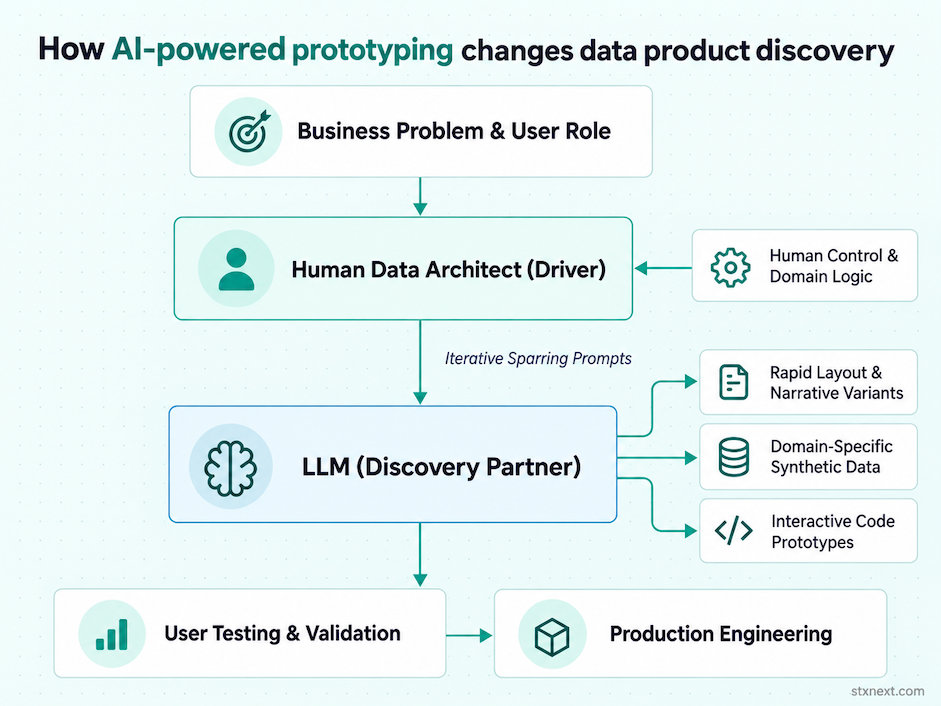
By leveraging conversational AI in discovery, you can test dozens of information architecture variants in a single workshop session, identifying the golden layout before touching your enterprise data warehouse.
How the discovery workflow operates in practice
Applying an AI-augmented discovery framework follows four distinct stages.
Defining the narrative and data storytelling architecture
Before choosing charts, you must establish the user's mental model and information hierarchy.
We use LLMs to challenge our initial assumptions about layout density and metric sequencing. By feeding the AI specific user personas (such as a Chief Risk Officer or a Regional Logistics Manager), we prompt the model to critique proposed visual structures:
- Which three metrics must be visible within five seconds of loading?
- Does this visual grouping force the user to calculate deltas mentally?
- Is the chart count on this page creating unnecessary cognitive friction?
This iterative sparring helps refine the data narrative, determining exactly how many visual components belong on a single view and ensuring a high Signal-to-Noise Ratio.
Generating context rich synthetic datasets
Testing dashboards with random numbers (1, 2, 3) or uniform dummy data hides critical UI flaws. Real-world business data is messy, asymmetric, and full of outliers.
Using LLMs, we generate structured, domain-specific synthetic datasets in JSON or CSV format that mirror actual business logic. For example, when prototyping a healthcare analytics application, we instruct the model to generate data that includes:
- Seasonal fluctuations in patient intake
- Anomaly spikes in specific facility locations
- Edge cases such as missing entries or extreme variance
Generating realistic synthetic data in discovery takes minutes instead of days of pipeline preparation. It allows stakeholders to interact with numbers that look, feel, and behave like their actual operations, surfacing misalignments in metrics immediately.
AI-powered rapid prototyping before engineering begins
Once the narrative and synthetic data are established, we use the LLM to write lightweight, functional code snippets using HTML/Tailwind, Streamlit, or Vite to render interactive web prototypes.
Using generative AI for dashboards works best as an early discovery simulator. It helps teams iron out layout hierarchy, interaction edge cases, and user flow well before committing engineering bandwidth.
Because these prototypes are decoupled from enterprise databases, they can be modified on the fly during client workshops. If a stakeholder notes that a stacked bar chart confuses their team, we can alter the prompt, update the layout code, and re-test an alternative visual in under two minutes.
Validating cognitive load and persona match
Finally, the prototype is tested against the target audience's operational needs. AI can assist in simulating persona interactions to check for usability bottlenecks:
- Executive Views - High aggregation, clear primary metrics, minimal clutter.
- Operational Views - High-density grids, fast filtering, deep-drill capabilities.
By validating whether a layout serves its intended user persona during discovery, we ensure that the final product addresses genuine user pain points.
Measurable business impact of AI-powered prototyping
Adopting AI-augmented prototyping in data product design delivers measurable improvements across project lifecycles:
Key benefits of AI rapid prototyping for enterprises
- Drastic Reduction in Engineering Waste: Front-end and data engineers receive a fully validated, user-tested specification rather than vague requirements.
- Higher Dashboard Adoption Rates: Products designed around clear cognitive models experience significantly less user resistance post-launch.
- Safer Exploration: Teams can test bold or non-traditional visualization formats without sinking budget into custom code that might get scrapped.
Common AI-powered prototyping pitfalls to avoid during implementation
While AI accelerates discovery, it requires strict guardrails to remain effective:
- Unchecked AI Visual Hallucinations
LLMs may suggest complex, non-standard charts that look impressive in theory but are practically impossible or inefficient to build in standard enterprise BI stacks like Power BI or Tableau. Always ensure the data architect grounds the AI in the capabilities of the target delivery technology. - Losing Human Direction
Letting the AI make final choices on business metrics leads to generic, cookie-cutter layouts. The AI is the executor and sparring partner; the human architect owns the domain logic and strategic intent. - Confusing Prototypes with Production Code
Fast-prototyped code generated during discovery is designed for validation, not production. It must be discarded or refactored according to enterprise engineering standards once requirements are frozen.
Where your team should start
If your organization is looking to streamline data product delivery and eliminate costly redesign cycles, consider these steps:
1. Select a single high-impact initiative
Pick an upcoming dashboard refresh or data application project that currently suffers from unclear requirements.
2. Establish an AI sparring protocol
Equip your data experience lead or BI architect with structured prompts designed to challenge dashboard layouts, generate synthetic JSON data, and draft quick layout code.
3. Run a live discovery workshop
Instead of presenting static slides to stakeholders, build and adjust a lightweight prototype live in the session using synthetic data.
4. Freeze requirements before engineering
Pass the validated prototype and user-tested logic to your engineering team as the single source of truth for build out.
By validating data logic, storytelling, and user experience before writing production code, organizations can protect their BI budgets and deliver data products that drive real business action.


