


Introduction
I spent eight years as an aviation engineer, including time as Senior Engineer and Controlled Title Holder at a leading engine manufacturer. I participated in the design of a new engine from the preliminary stages to deep testing. So, I’m not an AI expert who later got interested in aviation. I’m an aviation engineer first who came to predictive maintenance through real-world challenges: keeping certified engines safe, reliable, and profitable every day.
For decades the industry relied on two approaches. Reactive “fix it when it breaks” repairs (which cause expensive Aircraft on Ground events) and strict fixed-interval inspections that often replaced perfectly good parts “just in case.” Now airlines face intense pressure. Rising fuel and labour costs, investor expectations, and the constant demand for high dispatch reliability – while airworthiness remains absolutely non-negotiable.
Predictive Maintenance (PdM) offers the bridge between these two approaches, i.e., better efficiency without sacrificing safety. In aviation, unlike many other sectors, every PdM model must be thoroughly validated and explainable. A forecast is only acceptable if a CAMO and regulator can clearly understand why it was made and confirm it respects all certification limits.
In the sections ahead, I’ll dive into the key challenges of mission-critical PdM implementations including safety risks and compliance hurdles. I’ll also explore the quantitative and qualitative data types that truly power effective analytics in our field.
What makes predictive maintenance in aviation unique?
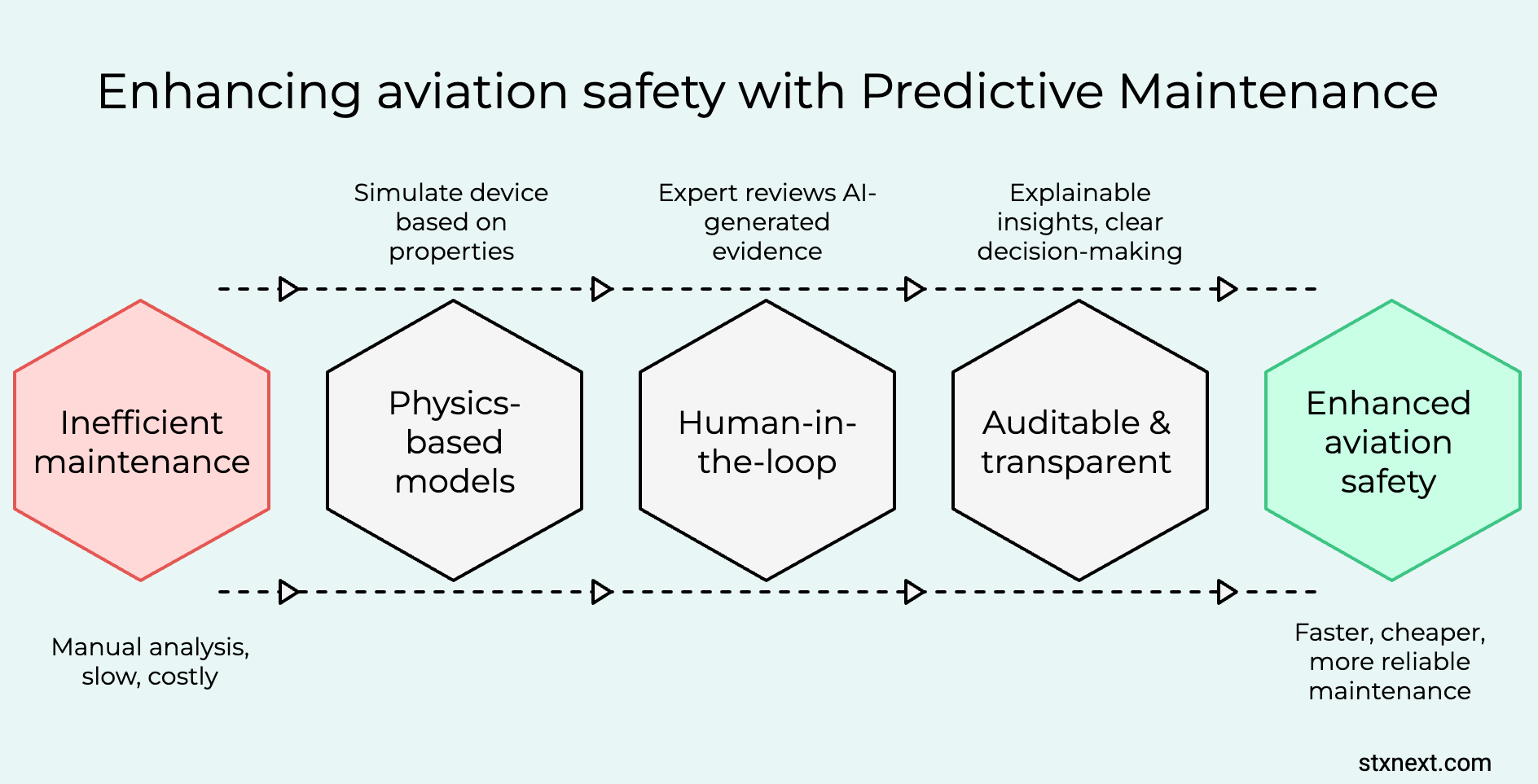
Predictive maintenance in aviation can only succeed if it is auditable, transparent, and human-controlled. In this industry, every insight must be explainable. Here are the main aspects that make PdM projects in aviation differ from other industries.
The rigor of airworthiness
Unlike many industries where an unexpected breakdown is merely a financial loss, aviation is governed by strict airworthiness standards. When we design and deploy an engine, we must prove it is fit to fly. This revolves around calculated life. We might determine a component must be replaced every 5,000 cycles. However, a "cycle" isn't a static unit. A high-power takeoff from a short runway or a hard landing "eats" more life than a standard mission.
The high stakes of life extension
Say that a fleet approaches its 5,000-cycle limit. We don't necessarily scrap the hardware, because we might launch Life Extension programs instead. This is essentially a secondary certification process.
When I worked in the aviation sector, it would usually mean that a dozen or so engineers spent six months performing deep manual analysis to prove a part can safely reach 10,000 cycles. The AI opportunity here is that a predictive model can analyze years of operational data and inspections to accelerate these retrospective analyses. It can help identify exactly where the Gaussian distribution of wear allows for extra margin.
Physics over pure probability
In aviation, physics-based models win over standard machine learning. Rather than just finding patterns in data, we create a simulator of the device based on its physical properties to count its life accurately.
At this point, I’d like to share a fundamental truth from my field. If I were an engineer at an aviation organization, I’d rather use an older, "clunkier" model that is fully explainable than a cutting-edge one that cannot be audited. These projects must always maintain a human-in-the-loop approach.
Naturally, predictive maintenance does not override the maintenance schedule, but it informs the governance. No model will ever unilaterally decide a plane is safe to fly, it provides the evidence so that a human expert can sign their name to that decision.
Maintenance approach comparison
Business benefits of predictive maintenance in aviation
Predictive maintenance creates value in aviation by reducing disruption, lowering avoidable costs, and improving decision-making around airworthiness and fleet operations.

Reducing unplanned downtime and AoG events
Aircraft on Ground events are one of the clearest costs of reactive maintenance. Every day of unscheduled downtime can mean $10,000 to $150,000 in lost revenue, even before crew disruption and slot penalties are included. Monitoring signals such as EGT margin, vibration behaviour, and structural wear helps maintenance teams identify emerging issues early and shift work into planned maintenance windows.
Lower maintenance costs over the fleet lifecycle
The financial case is not only about avoiding failures. Predictive maintenance also reduces unnecessary preventive work on parts that still have usable life. At the same time, it limits the premium costs of unscheduled repairs, including expedited parts, unplanned labour, and operational disruption. It also improves spare-parts planning by giving teams more time to source components through standard lead times.
Enhanced safety and audit readiness
In aviation, maintenance strategy must support airworthiness. A predictive approach helps teams detect deviations before they become in-service events or breach certification limits. It also strengthens auditability, because maintenance actions can be linked back to operational data, historical records, and documented model outputs.
Operational efficiency and fleet management
Unplanned maintenance disrupts more than a single aircraft. It affects rotations, schedules, crew allocation, and the wider operating model. When teams can see likely failures in advance, they can protect aircraft availability, reduce knock-on disruption, and make fleet planning more stable.
How does predictive maintenance work in aviation?
Predictive maintenance uses AI and data analytics to replace fixed maintenance assumptions with evidence from actual aircraft operation. The goal is to detect patterns that suggest a component is moving toward failure and give maintenance teams enough lead time to act before that fault creates a safety or operational problem.

Data collection from aircraft components
Modern aircraft produce large volumes of data from engines, airframes, and onboard systems. Sensors capture temperatures, pressures, vibration levels, and performance parameters. Combined with onboard monitoring outputs and maintenance history, this becomes the basis for predictive analysis. As in any ML system, data quality determines model value.
Machine learning and predictive models
Data scientists and aviation engineers use this data to build models that identify patterns associated with developing faults in critical components. Instead of waiting for a threshold breach or a scheduled inspection, teams can estimate whether a part is likely to degrade before the next maintenance opportunity. That makes it easier to prioritise action across the fleet.
Human review and maintenance action
In aviation, no model acts alone. Predictive systems surface risk signals and supporting evidence, but qualified personnel review the output and decide whether maintenance action is justified. That is a regulatory requirement. AI improves the speed and quality of analysis, while human oversight keeps the process operationally and legally sound.
Handling mission-critical implementations: Main challenges
Three challenges dominate aviation Predictive Maintenance implementations. Notice that only one is informed by cost-savings, and the latter prioritize safety over expenses.
Challenge 1: Handling aircraft on ground (AoG)
In aviation, even short unscheduled downtime can lead to “minor” issues, like flight delays and cancellations, and such events cost millions. Some of these are completely outside of anyone’s control (think sudden storms or volcano ash clouds that deem entire continents “unfylable”). So, it’s not surprising that flight operators try to minimize those that are within human supervision and prediction capabilities. Air Cargo Week reported that engine replacements alone can hit $200,000–$2M+, plus revenue loss of $10,000–$150,000+ per day.
PdM can help spot these and any other technical issues that could ground an aircraft and make operators incur these costs.
Challenge 2: Preventing safety incidents
In aviation, safety is number one priority. Predictive maintenance must strengthen airworthiness, never risk it. Even a small oversight can cascade into catastrophe, so every PdM deployment carries mission-critical weight.
Two persistent hurdles stand out from my engine-program days.
First, data silos plague legacy systems. Engine health data lives in one platform, airframe structural logs in another, flight ops in yet a third. This fragmentation blocks a true holistic view of aircraft condition, causing models to miss vital cross-correlations, like how cabin pressure cycles accelerate fatigue in seemingly unrelated components.
Second, sensor data is noisy and often poor quality. Modern jets stream thousands of parameters in real time, but environmental interference, sensor drift, calibration drift, missing values, or duplicates introduce errors. “Garbage in” means unreliable predictions – false alarms waste resources, while missed signals erode the safety margin we can't afford to lose.
Overcoming these requires relentless data governance, cross-system integration, and rigorous quality filtering – without any shortcuts.
Challenge 3: Compliance
Compliance in aviation predictive maintenance is the foundation. Operators must prove that any AI/ML models, software, or data systems used for PdM are fully traceable, auditable, and aligned with airworthiness requirements. This demands phased regulatory approvals, explainable algorithms (no true black boxes allowed), and strict adherence to key frameworks like FAA Advisory Circulars and EASA Part-M.
My British mentor used to say, “Data is always humbling.” No matter how sophisticated the model, the data underneath is the ultimate truth. Humans sign off on that data with personal accountability. If something goes wrong, regulators like the FAA or EASA come knocking on those doors first. Safety always trumps cost; redundant systems exist precisely because one failure can be catastrophic.
Key regulations include:
- FAA AC 43-218 (Operational Authorization of Integrated Aircraft Health Management Systems, 2022). Provides guidance for operators to develop and gain approval for Integrated Aircraft Health Management (IAHM) programs, using onboard sensors, data transmission, and analysis to support airworthiness decisions while enhancing safety and efficiency.
- FAA AC 120-16G (Air Carrier Maintenance Programs, 2016). Outlines the 10 essential elements of an air carrier's maintenance program (e.g., airworthiness responsibility, manuals, organization, schedules, training, and Continuing Analysis and Surveillance System), ensuring aircraft remain airworthy through structured, auditable processes.
- EASA Part-M (Continuing Airworthiness Requirements, under Regulation (EU) No 1321/2014). Establishes rules for managing continuing airworthiness of aircraft and components, including approval of Continuing Airworthiness Management Organisations (CAMOs), maintenance programs, airworthiness reviews, and traceability to keep aircraft safe and compliant throughout their lifecycle.
In PdM, these demand rigorous validation of every prediction against certification limits, because airworthiness isn't negotiable.
Regulatory direction to watch: Beyond listing requirements, the FAA is now actively developing a certification program specifically for AI/ML systems in aviation maintenance. Any organization that must be FAA- or EASA-compliant should monitor these changes and build regular regulatory review into their PdM governance process.
Types of data and analytics that power PdM in aviation
Predictive Maintenance (PdM) in aviation draws on a spectrum of quantitative and qualitative analytics, but quantitative data dominates due to its precision and traceability, which are essential for airworthiness decisions.
Quantitative data sources

Near real time - Aircraft Condition Monitoring System (ACMS)
The ACMS is the backbone of near real-time quantitative monitoring. Rather than streaming full high-resolution time-series data continuously, it triggers automated reports at predefined logic points, most commonly during stable cruise phases where altitude and speed are constant.
These pre-processed snapshots capture:
- Engine performance parameters
- Vibration levels
- Temperatures and pressures
- Fuel flow and efficiency metrics
Rather than full high-resolution time-series transients, ACMS triggers automated reports at predefined logic points – such as stabilized cruise – sampling engine performance, vibration, temperatures, pressures, and more. These pre-processed, limited datasets are transmitted via datalink (e.g., ACARS) or downloaded post-flight, often accessible directly to engine manufacturers who hold the most detailed insights on their hardware in operational use.
This near-real-time quantitative stream enables trend monitoring, anomaly detection, and prognostic models that forecast component degradation with statistical confidence.
Quick access recorder (AQR)
In the hierarchy of aviation data, it’s the QAR that provides the ultimate reality check. The data streams in after the aircraft arrives at its destination. And once this high-fidelity data is harvested after landing, it becomes our "ground truth."
Something I always emphasize is that, no matter how sophisticated your predictive model is, raw data remains the final authority. You can build the most elegant simulations imaginable, but the physical reality captured by the QAR often has a way of correcting your assumptions. In predictive maintenance, we don't argue with the recorder. We use its precision to ground our analytics in what actually happened in the sky.
EGT/ITT margins
If you want to know the "health" of an engine, you look at the Exhaust Gas Temperature (EGT) or Interstage Turbine Temperature (ITT) margin.
Physics dictates that an efficient engine runs cooler. As components deteriorate due to increasing blade tip clearances, seal wear, or environmental "fouling" like sand and volcanic ash, the engine must work harder and run hotter to produce the same thrust.
The EGT margin is the result between the current operating temperature and the maximum allowable limit. That’s why it’s the best indicator of remaining engine life. The engine’s digital controller monitors this constantly to ensure we don't exceed safety thresholds during takeoff. In predictive maintenance, tracking this margin allows us to forecast exactly when an engine will "run out of breath" and require an overhaul before the hardware fails.
Qualitative data sources

While quantitative streams like ACMS provide the backbone of near real-time monitoring, qualitative data adds critical human-observed context that pure numbers often miss. Especially for complex degradation modes visible only during physical inspections.
Borescope inspection imagery
The richest qualitative source is borescope inspection imagery. Aircraft engines feature dedicated borescope ports. These are small access holes that allow flexible cameras (similar to medical endoscopes) to peer inside without disassembly. Technicians rotate the rotor slowly, capturing high-resolution photos and videos of individual blades, combustion chambers, cases, and other internals.
Borescope inspections reveal:
- Cracks and their propagation between inspections
- Denting, erosion, or burning on combustion liners (non-structural but performance-critical)
- Foreign object damage (FOD), coating loss, or thermal distress on cases and structural elements (safety-critical)
During major overhauls, engines are fully disassembled, generating thousands of detailed photographs alongside shop findings. These are cross-referenced with the engine’s operational history: flight cycles, mission profiles (passenger vs. cargo – cargo ops often impose harsher loads), environmental exposure, and performance margins.
Maintenance logs, pilot squawks, and technician notes
These records add the human-observed context that pure numbers miss. Unusual noises during taxi, vibrations felt during ground runs, observed anomalies reported by crew, and technician notes from previous inspections all enrich the dataset. In Predictive Maintenance, these qualitative inputs help validate physics-based models against real-world behavior rather than statistical fits alone.
Why does this matter for PdM? Aviation demands explainable models grounded in physics and real-world behavior, not just statistical fits. Validation here is rigorous: compare model predictions against successive borescope or overhaul findings. If the model correctly flags a propagating crack that later confirms on inspection, Chief Engineers can approve it for fleet use. Consistent camera positioning (e.g., fixed-angle systems with rotor indexing) also helps standardize images, making crack detection and measurement more reliable for AI.
Case study: A digital twin for EGT margin monitoring
I’d now like to share an example of a PdM project I worked on, which was a digital twin that allowed us to track EGT margin recovery and deterioration.
The challenge
Airlines operating mixed-age fleets need to know in advance when individual engines will reach their performance limits, not just what the average fleet is doing.
For starters, we used historical flight data and open-source aviation datasets to build a time-series model. This model now predicts how an engine’s performance decays based on how it is actually flown.
Our goal was to ensure high-fidelity forecasting. So, together with my team, we moved beyond simple linear projections and fed the model critical features, like takeoff thrust, mission duration, ambient temperature, and hard landings.
These variables define the engine's unique "wear curve." For example, an engine operating in high-heat environments needs more fuel to reach the same thrust. This raises internal temperatures and speeds up deterioration. Physical wear, such as blade tip clearance (where the rotor rubs the casing), also hits efficiency hard. A model like ours can capture these specific factors to show exactly how much performance life remains.
Outcomes
The goal of this digital twin was to remove the element of surprise from maintenance. By seeing if an engine is following a normal path or deviating because of an issue, like damaged turbine tips, flight operators can now make several smarter choices. These are:
- Preventing useless grounding – we know exactly when an engine hits its limit.
- Mission optimization – if a model shows rapid wear, we can move that engine to "lighter" flight paths to keep it in service longer.
- Fuel economy – lower efficiency means burning more fuel. We use the data to find the right time for an overhaul before fuel costs spike.
Once again, the model shows us the trajectory, but the human-in-the-loop stays essential. The AI provides the evidence, but the expert makes the final call on fleet health.
Predictive maintenance in aviation: Key takeaways
In this industry, trust is earned through transparency. We cannot afford to rely on a model that gives a "black box" answer without showing its work.
We must also bear in mind that agencies like EASA and FAA all need to keep up with the changing world, new technology development, and adjust their regulations accordingly. While the former lists requirements, The FAA seems to be going a step further and is now working on a certification program. This, in turn, means that all companies that must be EASA- or FAA-compliant must also regularly review these regulatory changes.
Whether we are monitoring EGT margins or building digital twins, the goal is to provide human experts with clear, physics-based evidence. We need to see exactly why a model suggests an engine is deteriorating. This level of insight allows us to move from reactive repairs to proactive fleet management without ever compromising on safety. In the end, AI is a tool to sharpen our decision-making, but the human signature remains the final word in airworthiness.
Building predictive models for high-stakes industries calls for more than just data science; it requires an understanding of rigorous safety standards and the need for absolute transparency.
Working on a PdM project in aviation or another safety-critical environment?
At STX Next, we build auditable, explainable predictive maintenance solutions for sectors where there is no room for error. We know how to integrate PdM analytics into existing certification and governance processes without creating new compliance risk.
Explore our predictive maintenance solutions or reach out directly to discuss your specific environment.


