


Introduction
A manufacturing data lakehouse combines the flexible storage of a data lake with the structure, governance, and analytics capabilities of a data warehouse. For manufacturers, it provides a way to bring together OT data from machines and plant systems with IT data from production, maintenance, quality, and business applications.
That connection becomes especially important when something goes wrong on the shop floor.
Unplanned downtime has traditionally been treated as an equipment reliability issue, a maintenance planning gap, or an operational execution failure. In high-throughput production environments, recurring downtime also points to a deeper problem: fragmented data architecture and limited integration between Operational Technology (OT) and Information Technology (IT) systems.
The operational impact can be substantial. McKinsey reports that maintenance drives between 30% and 50% of overall equipment effectiveness losses in heavy industries.
At plant level, even a single hour of unexpected production stoppage in automotive, chemical, or pharmaceutical environments can cost tens of thousands to several hundred thousand euros, depending on process complexity and throughput.
Downtime as a data architecture symptom
Mechanical failures and wear remain important contributors to downtime. But the duration and recurrence of these events are also influenced by fragmented data landscapes.
When a production line stops, the immediate technical issue may be localized. Understanding why it occurred and how to prevent recurrence requires information that is often dispersed across several systems.
Machine data may reside in PLCs or historians. Production context is recorded in MES systems. Maintenance records are stored in computerized maintenance platforms, while quality deviations are documented separately. ERP systems contain supplier and material data.
Each system holds part of the story.
When these systems are poorly integrated, investigation becomes manual, time-consuming, and prone to error.
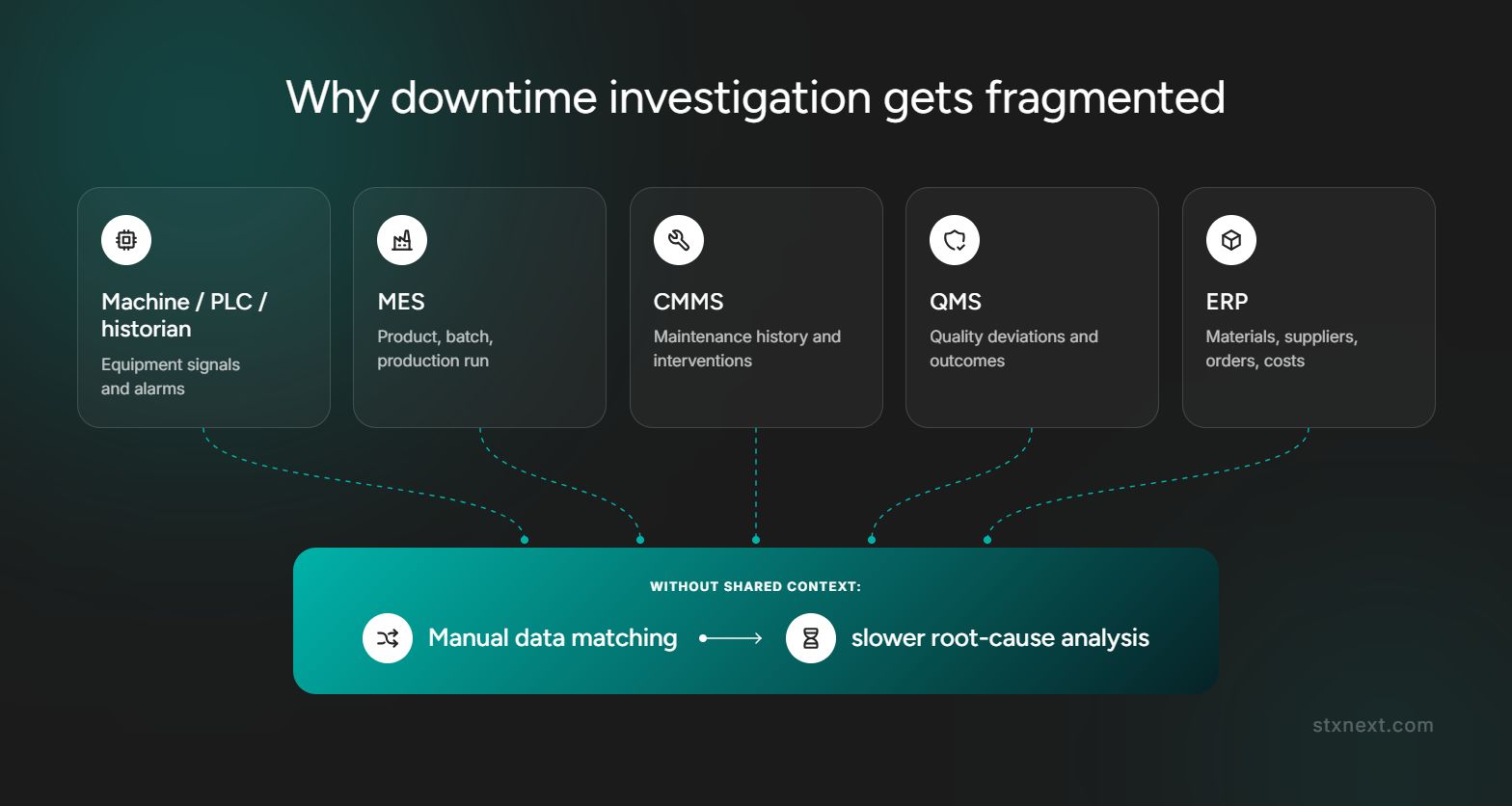
Engineers must extract logs from control systems, cross-reference production orders, consult maintenance records, and reconcile timestamps across platforms. If timestamps are misaligned or naming conventions differ, additional delays follow.
Valuable time is spent gathering and matching data before teams can fully investigate the issue. In high-throughput environments, those delays can quickly translate into significant financial losses.
Weak integration between operational technology and information technology also slows decision-making. OT teams may focus on restoring equipment functionality, while IT teams manage data access and reporting pipelines. Without a shared operational data foundation, information remains fragmented across teams and systems.
Even when the data exists somewhere in the organization, it may not be accessible when it is needed.
Repeated downtime events can also point to architectural weaknesses. When root-cause investigations repeatedly require manual data stitching, spreadsheet analysis, or ad hoc queries across systems, it becomes harder to:
- identify patterns across previous events,
- detect recurring parameter deviations,
- correlate supplier variability with equipment performance,
- compare incidents across production runs.
Effective downtime analysis requires machine-level signals, MES production records, quality outcomes, and maintenance histories to be viewed within the same time-aligned context.
Teams need to understand what the machine was doing, which product was being manufactured, which materials were used, what maintenance interventions occurred, and whether quality deviations followed.
In many manufacturing environments, assembling this view is still difficult, slow, and inconsistent.
Downtime, therefore, should be understood as a wake-up call. It reveals not only operational vulnerabilities but also the limitations of fragmented data architectures. Organizations that continue to address downtime solely through reactive maintenance or localized process improvements risk overlooking the systemic data integration challenges that prolong outages and prevent sustainable performance gains.
Addressing those gaps requires an integrated data foundation that brings OT, MES, ERP, quality, and maintenance information together. A manufacturing data lakehouse provides that common layer, giving teams the context they need to investigate production events across systems.
This kind of data foundation can also support measurable operational improvements. In one chemical industry project, STX Next built a scalable data platform for real-time factory telemetry, helping the client use operational data for production analytics and predictive maintenance.
Manufacturing data integration challenges across OT and IT systems
Manufacturing data presents structural challenges that differ from those found in purely transactional or digital-native industries. To understand why conventional data architectures often struggle in industrial environments, it helps to look at the fragmented OT/IT landscape in which manufacturing data is generated and used.
Manufacturing data hierarchies, time alignment, and production context
Manufacturing environments are inherently hierarchical. Physical production systems are typically structured from plant to line to machine to component, and each level carries operational meaning.
A signal generated by a motor does not exist independently. It is associated with a machine, which belongs to a production line, which operates within a specific plant. These relationships influence performance measurement, maintenance strategies, scheduling, and accountability.
At the same time, manufacturing data is strongly time-based and highly dependent on production context.
Different systems also record time differently. Some use local clocks, others rely on centralized time servers, and levels of precision vary. Historians may capture continuous streams of signals, while other systems record discrete events or delayed transactional entries.
Reconciling these different timelines is difficult. Without reliable time alignment, it becomes harder to establish causality or understand what happened before, during, and after an event.
Context adds another layer. The same machine can produce different products, operate under different recipes, or run during different shifts with different operator teams. A parameter value that is acceptable for one product may be out of tolerance for another. A vibration pattern that is normal during high-speed production may indicate a fault during low-speed operation.
Data therefore has to be interpreted alongside the product being manufactured, the batch or lot number, the specific operation being performed, and the conditions around the process at that time. Context is essential to interpretation.
Data fragmentation across OT and IT systems
The number of systems involved adds to the problem. Operational and business data may come from:
- SCADA systems and industrial control systems,
- historians,
- Manufacturing Execution Systems (MES),
- Enterprise Resource Planning (ERP) applications,
- Quality Management Systems (QMS),
- and Computerized Maintenance Management Systems (CMMS).
Each system was typically designed independently to serve a specific function. As a result, naming conventions, data formats, and definitions can vary widely.
A machine may be identified differently in the maintenance system than in MES. Downtime categories may differ between operations reporting and financial reporting. Even basic concepts such as production time or yield can have more than one definition depending on the system of record.
This semantic inconsistency makes unified analysis difficult without a shared operational model.
Seasonality and planned shutdown periods add another complication. Many manufacturing facilities operate with cyclical demand patterns, annual maintenance shutdowns, or product changeovers that create gaps and shifts in the data.
These patterns can distort trend analysis and machine learning models if they are interpreted as normal operating periods. Manufacturing data therefore has to reflect planned interruptions as well as production activity.
Legacy infrastructure and organizational silos
Legacy infrastructure remains a major obstacle. Many facilities operate machinery that was not designed for modern data integration. Some equipment lacks native connectivity or produces data in proprietary formats.
In some cases, production data must be extracted manually or equipment needs to be retrofitted with external sensors to enable digital capture. This creates uneven data availability across assets and plants, making standardization harder and reducing real-time visibility.
Organizational fragmentation often mirrors the technical fragmentation. OT and IT teams may operate separately, with different priorities, governance structures, and budgets. Engineering, production, quality, maintenance, and finance functions may also maintain their own reporting processes and definitions.
Limited coordination between these teams can prevent data from reaching the people who need it. Even when technical integration is possible, differences in ownership, definitions, and governance can slow its use across the organization.
Taken together, these factors explain why manufacturing data is difficult to manage at scale. It is hierarchical, time-based, context-dependent, spread across multiple systems, affected by planned production cycles, constrained by legacy infrastructure, and often divided across organizational silos.
A manufacturing data architecture needs to account for all of these characteristics if it is going to support reliable analysis and scale across plants, teams, and use cases.
Data engineering services can help integrate these sources, standardize data pipelines, and build the foundation needed for reliable cross-system analysis.
Where traditional data architectures fall short in manufacturing
Despite significant investment in enterprise data platforms, many manufacturers struggle to get sustainable value from their data initiatives. Traditional architectures, whether centralized data warehouses, standalone data lakes, or loosely integrated “lake plus warehouse” environments, were not originally designed around the way manufacturing data is generated and used.
High-frequency OT data, changing asset structures, production context, and different definitions across systems create problems that these architectures handle with varying degrees of success.
Limitations of traditional data warehouses and OT data
Traditional data warehouses were designed to manage structured, transactional business data. They work well with discrete records such as orders, invoices, inventory movements, and financial transactions. Their schemas are optimized for stable entities and predictable relationships.
Operational technology data behaves differently. Sensor signals are continuous, high-frequency, and time-dependent. A single asset can generate thousands of tags, each producing data points at sub-second intervals. This data is temporal and state-based rather than naturally transactional.
When time-series OT data is forced into traditional warehouse schemas, several issues emerge. The volume and velocity put pressure on storage and compute models designed around periodic batch updates. Data modeling becomes rigid, with predefined schemas that are harder to adapt as tag structures change or new equipment is introduced. Time-window queries and signal-based analytics can also become expensive or difficult to manage.
As a result, granular OT data is often aggregated before it reaches the warehouse or kept elsewhere, reducing the level of detail available for analysis.
Traditional data warehouses remain useful for business reporting. They are simply a poor fit for modeling dynamic physical systems.
Why manufacturing data lakes become context-free storage
In response to warehouse limitations, many organizations adopt data lakes to store raw OT and manufacturing data. Data lakes offer scalable storage and flexibility, allowing high-volume time-series data to be ingested without strict schema constraints.
That flexibility creates another problem when the data lacks a manufacturing-specific operational model.
Sensor tags may be stored as flat files or tables without standardized naming conventions, asset hierarchies, or process associations. Metadata can differ between plants, while context from MES or ERP systems remains disconnected from the underlying time-series records.
Over time, the lake becomes a repository of signals rather than a useful representation of production. Analysts have to reconstruct context for each use case, which leads to duplicated logic, inconsistent interpretations, and limited reuse of analytical work.
This is where a data lake starts to resemble the familiar “data swamp”: the information exists, but using it reliably takes too much work.
The structural problems of the “lake + warehouse” split
To address the limitations of standalone warehouses and lakes, many organizations use a hybrid architecture: raw data stays in the lake, while curated information moves into the warehouse for reporting.
This pattern introduces several problems in manufacturing:
- Data duplication: Raw OT data remains in the lake while aggregated or transformed versions are replicated into the warehouse, creating multiple representations of the same signals.
- Processing delays: Data has to be extracted, transformed, and loaded before it becomes available for reporting. Where operational decisions need to happen within minutes or hours, that delay matters.
- Different KPI definitions: Logic for downtime classification, OEE, yield, or other metrics can be implemented differently across transformation and reporting layers.
The last point is particularly important. If different teams calculate the same KPI in different places, they can end up working from different versions of production performance.
Instead of bringing the data together, the separation between raw storage and curated analytics can introduce another layer of fragmentation.
Fragile data pipelines in changing production environments
Manufacturing environments are not static. Plants expand, equipment is upgraded, new machines are commissioned, tags are renamed, sensors are added, and process parameters change.
Each change can affect the pipelines built around that environment.
In traditional architectures, pipelines are often tightly coupled to specific tag names, table structures, or asset mappings. When a PLC configuration changes or a new machine is introduced, ingestion logic may need to change with it. Differences in naming conventions across plants add further transformation rules.
Over time, these pipelines accumulate hard-coded assumptions that make them increasingly difficult to maintain.
As the number of assets, plants, and tags grows, maintenance effort scales disproportionately. Minor operational changes can cascade into data quality issues, broken dashboards, or failed AI models. Instead of enabling agility, the data architecture becomes an obstacle to modernization.
Without a persistent operational model that abstracts physical changes from analytical logic, data pipelines remain fragile and difficult to scale.
Traditional data architectures address individual parts of the manufacturing data problem well, but each has clear limitations when used on its own:
- warehouses struggle with granular, high-frequency OT data;
- data lakes store that data more easily but can lose the context needed to interpret it;
- lake-plus-warehouse architectures introduce duplication, latency, and inconsisten metrics;
- tightly coupled pipelines become difficult to maintain as plants and equipment change.
These limitations underscore the need for a domain-aware operational foundation - one that integrates time-series data with execution and enterprise context in a coherent, scalable manner.
A manufacturing data lakehouse is designed to bring these pieces closer together. It combines scalable storage and analytics with the manufacturing context needed to connect time-series data, assets, production processes, and enterprise systems in a consistent model.
The manufacturing lakehouse as an operational model
A manufacturing data lakehouse is a data platform that combines the strengths of a data lake and a data warehouse to manage, analyze, and use manufacturing data in one place. It brings together information from machines and sensors on the shop floor with ERP, quality, supply chain, and maintenance data.
A generic data lakehouse is primarily a storage and analytics architecture. It combines scalable storage with structured querying and support for BI and data science workloads.
A manufacturing data lakehouse goes further. Its value comes from representing what the data means in an operational setting and connecting information across the systems involved in production.
A manufacturing lakehouse is therefore more than a place to store and analyze data. It also provides a common operating model for how that data is defined, governed, and used across the organization.
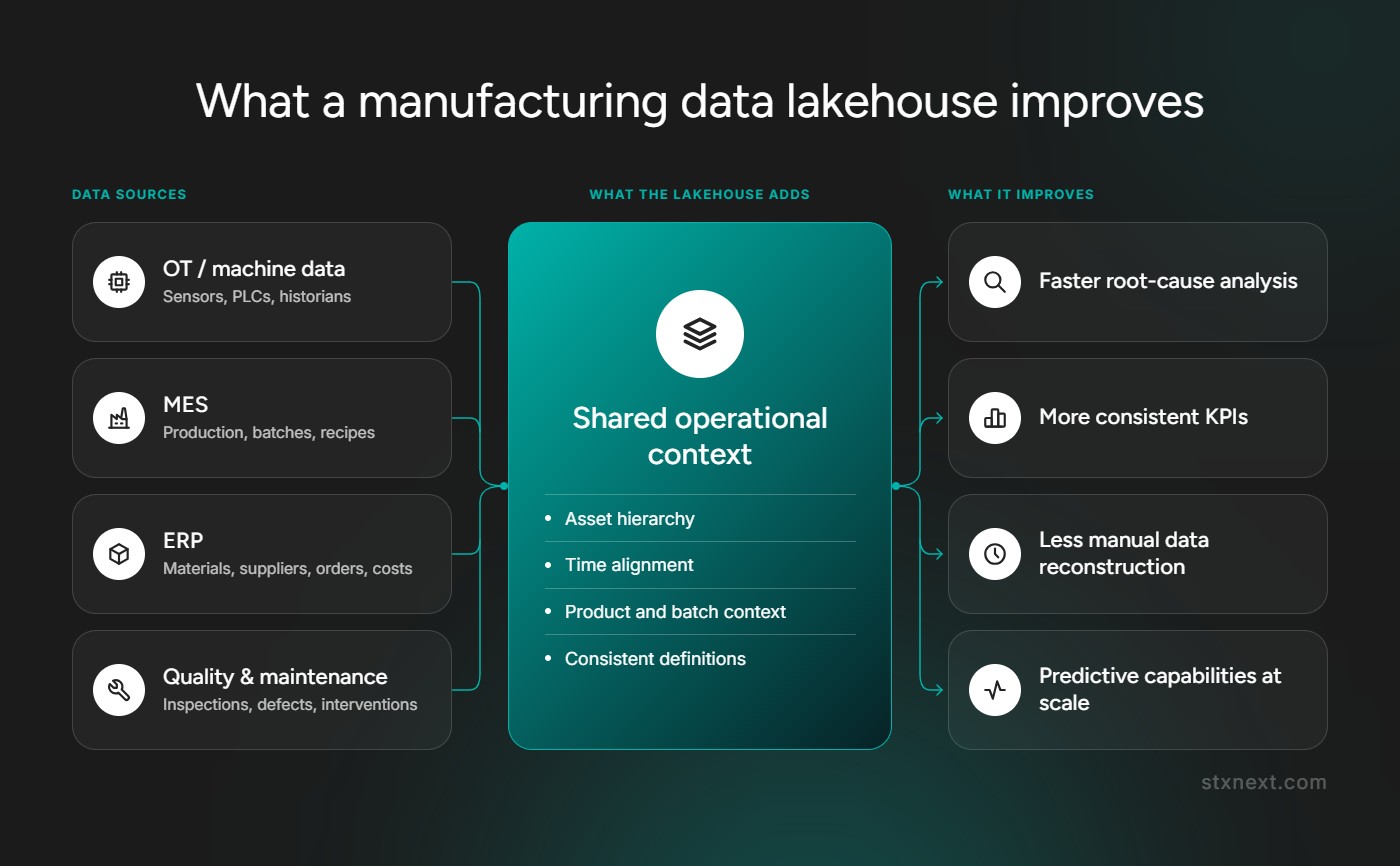
That includes ownership of asset hierarchies, KPI definitions, data quality, and access rules. It also affects how OT, IT, engineering, quality, and maintenance teams work together around the same production data, so definitions and context remain consistent across plants and use cases.
Many organizations adopt lakehouse technologies expecting faster analytics, lower costs, or better AI outcomes, yet struggle to translate those investments into useful results on the factory floor. One reason is that many implementations remain analytics-centric, while manufacturing needs data to reflect assets, production processes, time, and operational context.
Data lakehouse consulting services can help design the platform around these operational requirements rather than treating the lakehouse as a storage and analytics layer alone.
This distinction matters because manufacturing decisions are often time-sensitive. Quality issues, downtime, process deviations, and maintenance problems need to be understood while they are still operationally relevant.
Connecting time-series OT data with MES, ERP, and quality context
A key capability of a manufacturing data lakehouse is connecting continuous, high-frequency OT data with transactional manufacturing and enterprise systems.
These sources describe different parts of the production process. OT systems capture machine behavior. MES records what is being produced and how. ERP adds material, supplier, order, and cost information. Quality systems record the outcomes of production.
Bringing them together creates a more complete view of what happened and the conditions around it.
Time-series OT data
Operational technology systems continuously generate time-series data, including sensor measurements, PLC tags, machine state transitions, alarms, control parameters, and energy consumption readings. This data is granular, high velocity, and closely tied to physical equipment behavior.
On its own, however, time-series data lacks production and business context. A temperature reading, vibration signal, or motor current value may show that something changed, but it does not tell teams whether the change occurred during startup, steady-state production, a cleaning cycle, or idle time.
It also does not identify which product or batch was affected.
MES context
Manufacturing Execution Systems provide much of the production context needed to interpret machine behavior. MES platforms record production orders, batch execution details, work instructions, operator interactions, downtime classifications, and in-process quality checks.
They show which product was being manufactured, under which recipe, on which line, and during which time window.
A manufacturing data lakehouse aligns time-series OT signals with MES execution records on a shared timeline and associates those signals with the relevant production context. Sensor readings and machine states can be mapped to specific production runs, batches, or serial numbers. Machine state transitions can be linked to documented downtime events or process phase changes, while process parameters can be tied to recipe steps or operating modes defined within MES.
This allows teams to analyze process behavior at the level of individual batches or production runs. Instead of examining signals in isolation, engineers can evaluate parameter stability during a specific lot, investigate deviations that occurred during a particular shift, or compare how machine behavior changed between products.
This turns raw signals into data that carries clear operational meaning.
ERP context
Enterprise Resource Planning systems provide the broader business context around production. They contain customer orders, material master data, bills of materials, procurement records, supplier information, inventory movements, and cost structures.
Connecting this information with production data makes it possible to relate operational events to business outcomes.
Process conditions during a batch can be viewed alongside the raw material lots used. Supplier variability can be compared with yield performance. Scrap can be connected to cost, while downtime can be considered alongside delivery commitments and production plans.
This connection lets teams quantify how changes in production affect financial results and customer commitments. It also gives engineering and business teams a shared view of production performance and its business impact.
Quality systems
Quality systems introduce another critical layer of context, particularly in industries with stringent regulatory or compliance requirements. Laboratory results, inspection records, nonconformance reports, corrective actions, and statistical process control metrics represent outcome-based evaluations of production.
Quality results are often delayed relative to production events. A defect may be identified hours or days after the process conditions that caused it.
A manufacturing data lakehouse addresses this by preserving the historical link between time-series data, MES execution records, and quality outcomes. Once laboratory results or inspection findings are recorded, they can be mapped back to the exact:
- production windows,
- equipment states,
- parameter conditions that existed during manufacturing.
This supports retrospective root-cause analysis and predictive quality modeling. Organizations can identify which combinations of parameters consistently precede defects, detect early indicators of process drift, and establish tighter control boundaries.
In regulated industries, this traceability also strengthens audit readiness by maintaining a verifiable chain of evidence from raw materials through final product release.
Taken together, the integration of time-series OT data, MES execution context, ERP enterprise data, and quality outcomes creates a more complete view of manufacturing operations.
The manufacturing data lakehouse provides the environment in which these previously siloed systems can be aligned in time and context. That alignment supports reliable cross-system analysis, scalable AI use cases, and data-driven operational decision-making.
What a manufacturing data lakehouse should improve
The value should show up in daily operations: faster root-cause analysis, consistent KPIs across plants, and less time spent rebuilding context by hand for every investigation.
The point is not to create another reporting layer, but to make manufacturing data easier to interpret and use across operational teams.
Manufacturing performance depends on usable data
Industrial performance depends on mechanical precision, workforce capability, supply chain efficiency, and increasingly, the maturity of the organization’s data architecture.
Modern manufacturing operates in an environment defined by variability, customization, regulatory pressure, sustainability targets, and cost competition. Performance improvements depend on the ability to understand process behavior in context and in time.
That, in turn, depends on whether the data is usable. That means - whether it’s structured according to operational reality, time-aligned across systems, contextualized with product, batch, and process information, consistent across departments and plants, and trusted by the teams that use it.
From fragmented data to operational performance
Organizations with fragmented data architectures often face the same operational problems: prolonged downtime investigations, inconsistent KPIs, delayed quality analysis, duplicated reporting efforts, and fragile analytics pipelines.
A domain-aware manufacturing data foundation helps reduce the time between signal and insight, standardize metrics across plants, support predictive capabilities at scale, and align engineering, quality, maintenance, and finance around the same operational data.
As product complexity increases and margins tighten, a manufacturing data lakehouse can provide the shared operational context needed to connect machine data with execution and enterprise information and make that data more useful across plants, teams, and use cases.


