


How Paradox Interactive Unified Its Player Experience and Grew Engagement
This is the story of Paradox Interactive, a Swedish video game publisher behind some of the most beloved strategy franchises in the world, and how partnering with STX Next helped them replace a patchwork of legacy launchers with a single, player-friendly product.


The Software Behind Paradox Interactive's Strategy Empire
Paradox Interactive is a Swedish video game developer and publisher with over 25 years in the industry, a catalog of more than 100 titles, and a global community of over five million monthly active players.
It's safe to say that every self-respecting gamer has either played their games or at least heard of them. Their catalog of iconic titles, including Crusader Kings, Europa Universalis, Victoria, and Stellaris, has shaped what strategy gaming looks like.
Behind that catalog sits a complex distribution infrastructure. Paradox serves millions of players across platforms, runs a proprietary account system, and manages a vast library of mods and downloadable content. Doing that well, consistently, at scale, requires more than great games. It requires great software.
A Fragmented Ecosystem
Paradox Interactive takes its player experience seriously. That ambition, however, had run into a structural problem.
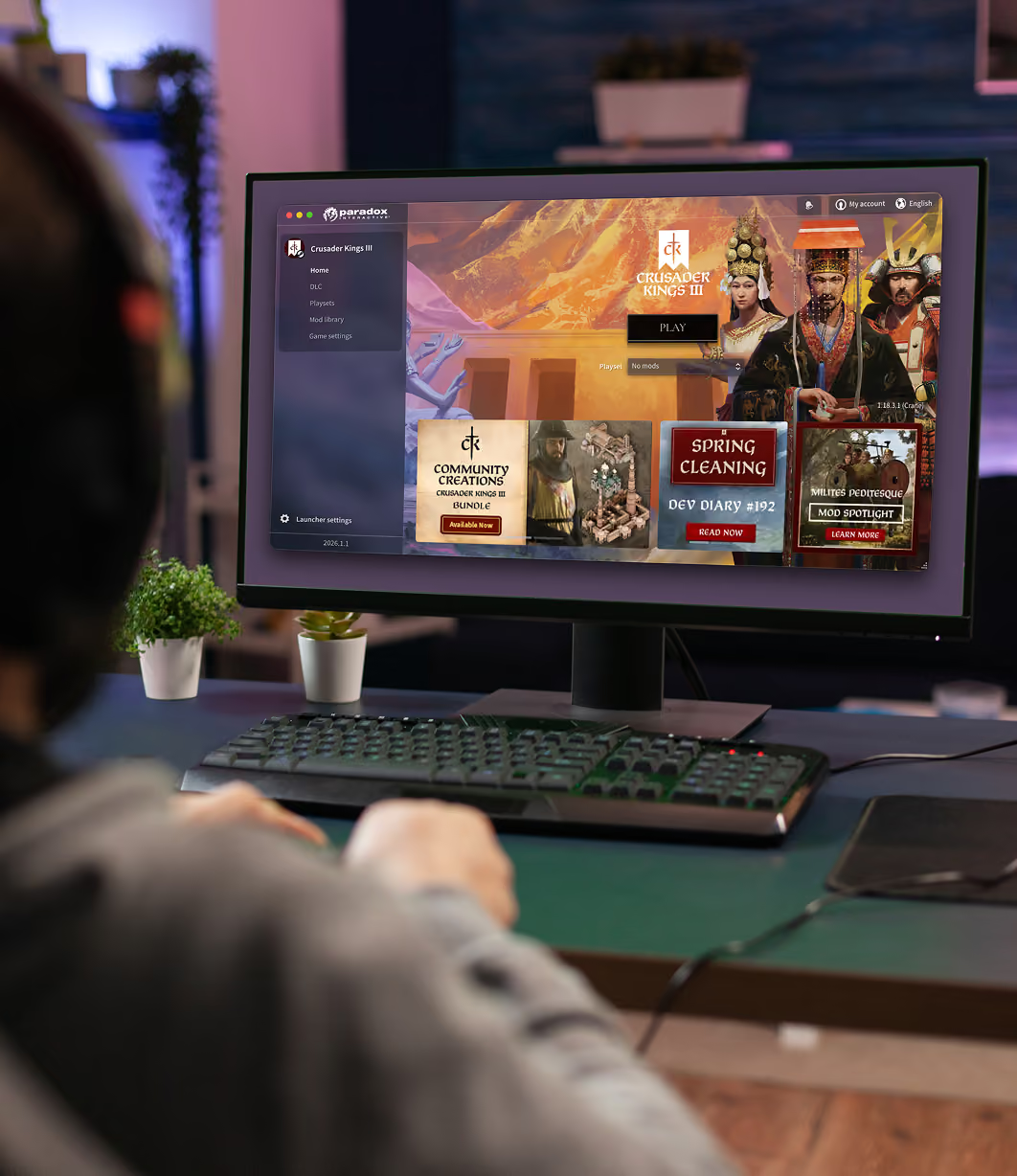
Over the years, each game had accumulated its own launcher. In addition to the game-specific launcher, there was a separate launcher for downloading and installing games directly from Paradox, simply called the Paradox Launcher. The challenge our team faced was to consolidate these different entities into one single launcher.
As the platform scaled, underlying technical complexity naturally grew. Handling platform-specific edge cases, particularly around Windows file paths and user data, offered an opportunity for greater standardization. At the same time, internal distribution tools built for earlier stages were creating operational friction. With internal talent rightly focused on core game development, the launchers lacked the dedicated bandwidth needed to fully realize their potential as engines for player growth, marketing, and DLC revenue.
Paradox needed a single launcher product to consolidate development costs and free up game teams. They also wanted it to serve as a marketing surface, a retention tool, and the front door to the entire Paradox catalog. The question was how to build it well, without disrupting the gaming experience for millions of players already using the existing solution.
Key challenges:
Legacy codebase with unreliable distribution and update pipelines
Platform-specific edge cases handled inconsistently or not at all
No unified product aggregating all games in one place
Inefficient internal admin tooling for managing distributions
Individual teams unable to prioritise launcher improvements

A Launcher Built Like a Product
STX Next joined as the dedicated development team behind what became Paradox Launcher v2: a complete rebuild and full migration away from the legacy v1 foundation.
Over the course of several years, the personnel setup changed with STX Next eventually entirely taking over the development effort and only product management remaining in-house with Paradox.
Two Modes, One Codebase
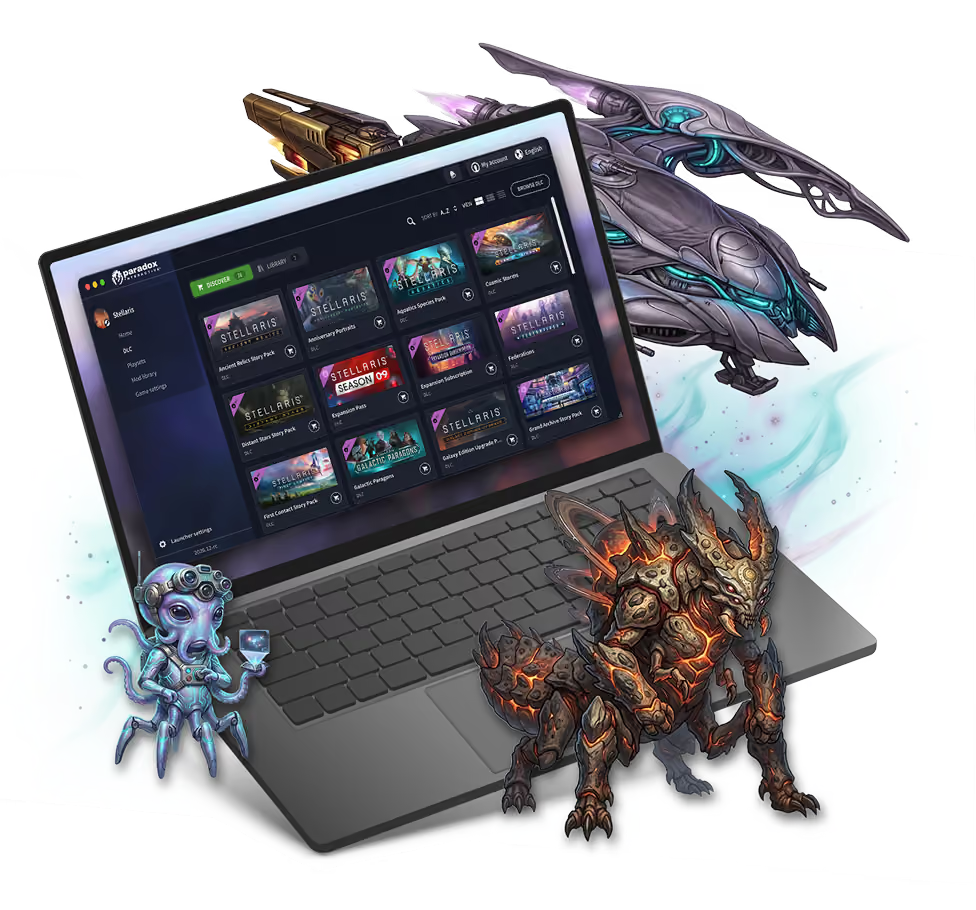
The launcher ships in two distinct configurations. The single-game mode is bundled directly with each game and serves players who launch through a specific title. Running the application in standalone Multilauncher mode gives players access to the full Paradox catalog in one place. Maintaining quality across both modes, without diverging into two separate codebases, was a deliberate and challenging design goal that the team achieved throughout the project.
How the Launcher Works
The feature set covers everything a modern desktop game launcher needs to do:
- Cross-platform installation, updates, and game launching with a bootstrapper and dowser system managing the self-updating functionality.
- DLC and mod management, including playset creation, upload, and cross-origin sharing between players.
- Per-game settings, graphics options, and language selection with localisation infrastructure supporting multiple languages.
- Full account onboarding, login, and registration flows connected to Paradox's account system.
- Diagnostics and repair flows tailored to specific platform edge cases, including Windows Documents-folder handling and forced-missing-docs scenarios.
- Support for Steam Deck and GeForce Now, handling the platform-specific requirements each demands.
- GDPR-compliant advertising surfaces for both logged-in and non-logged-in users, making the launcher a usable marketing channel.
- Transient game ownership handling, including integration with external distribution platforms so players can see and access games they own elsewhere.
The Admin Interface
Internally, Paradox staff use a bespoke Admin Interface built alongside the launcher. It models staged rollouts and per-DLC controls, giving the distribution team fine-grained control over how updates reach players. This replaced the inefficient tooling that had slowed down distribution work before.
Technical Approach
We chose Electron with React for the UI layer and Node.js for background services. This stack enabled rapid iteration on the interface while keeping the underlying service logic flexible and maintainable. Testing relied on Playwright for end-to-end coverage and Jest for unit and integration tests, supported by CI/CD pipeline work that kept the delivery process stable throughout development.
One of the more distinctive technical contributions was the platform diagnostics layer: repair flows that handle edge cases specific to how Windows manages user data folders, giving players clear recovery paths instead of cryptic errors.
All Games Gathered in One Place and an Increase in Engagement
We consolidated Paradox games – including those from third-party platforms such as Steam – into a single standalone multilauncher without disrupting the user experience. Player sentiment around the launcher remained stable throughout the migration, reflecting both the quality of the rebuild and the care taken in the rollout process.
Unified Game Libraries and Increased Engagement
An increase in player engagement was caused by integrating externally distributed games into the Paradox Multilauncher and bringing players' game libraries into one place.
A High-Performing Marketing Channel
The launcher is now one of Paradox's key marketing channels. The GDPR-compliant advertising surfaces built into the launcher outperform other available options in both cost-effectiveness and measurable impact. Having a dedicated team focused on the launcher, rather than game teams fitting it around other priorities, made this possible.
Driving Account Creation and Lifetime Value
Higher average lifetime value for account holders. The onboarding flow built into the launcher drives account creation, and account holders show meaningfully higher lifetime value than anonymous players. Every player who creates a Paradox account through the launcher is a player Paradox can reach directly for years.
Sustaining Retention Through Mod Support
Mod support drives retention, and retention drives DLC sales. The playset and mod management features give players more reasons to stay engaged with a game long after launch. Players who keep playing buy more DLC. The launcher makes that cycle easier to sustain.

Paradox Interactive x
STX Next
Paradox Interactive brought clear vision, open communication, and a willingness to trust the team. We provided them with technical expertise, a proactive approach to problem-solving, and the kind of ownership that goes beyond executing a ticket queue.
The key lesson from this project cuts against a common assumption in software consulting: you do not need to be building something new to build something great. A well-maintained, thoughtfully developed product can achieve the same kind of momentum as a greenfield project if the team treats it that way. Paradox Launcher is proof of that.
Are you ready to also transform your business?
Schedule a call with our experts to discover the benefits of partnering with STX Next.
Our customers love to work with us


