



Intro
Your ERP and CRM reports show different figures for the same metric. Every new data source requires another custom integration. And the AI initiative on next year's roadmap depends on historical data that existing pipelines were never designed to support.
You can tackle these problems one at a time. But that often means more engineering work, more maintenance, and another round of fixes when business requirements change.
An end-to-end data engineering partner brings together architecture, integrations, data quality, and production engineering expertise to turn fragmented source systems into a platform your teams will use for reporting, operational decisions, and AI.
End-to-end capability doesn't mean every project includes all these services. The scope depends on what the organization already has in place and where support is needed. What matters is that the responsibilities are clear and no critical gaps are left between architecture, implementation, and operations.
What does that mean for your business?
- Reliable reporting: Shared business definitions and automated validation reduce discrepancies between reports.
- Analytics and AI readiness: Reliable, accessible, and well-structured data supports analytical workloads and reduces data-related risks in AI applications.
- Less manual work: Automated pipelines and validation minimize the time spent reconciling reports and correcting records.
- Better cost control: Architecture and processing choices suited to your actual workloads help avoid unnecessary infrastructure and operational costs.
The table below summarizes the core data engineering provider capabilities, the work each covers, and the expected deliverables.
What end-to-end data engineering delivery involves
What are the core data engineering partner capabilities?
From architecture decisions to reliable pipelines and data prepared for analytics and AI, each area brings its own technical challenges and delivery requirements.
1. Analytics and AI data readiness: Preparing data for its intended use
Teams across your organization want to use AI to make decisions, analyze business performance, and build agents that automate work. Your data pipelines are running, and information from different systems is finally available in one place. But is that information reliable enough for the applications you plan to build?
Without a solid data foundation, AI may produce misleading results. Worse, employees end up acting on incorrect information while feeling confident in the answers they're getting.
Assessing data readiness before development helps identify gaps in data quality, accessibility, historical coverage, and infrastructure. A broader AI readiness assessment should also evaluate whether the intended use case is feasible and delivers sufficient business value.
A platform built for dashboards won't automatically support machine learning or AI search. A data engineering partner must understand what each application requires and design the datasets and pipelines accordingly.
The engineering requirements differ by workload:
The provider's responsibility is to make that data usable for the intended application, whether it's a reporting model analysts query or an indexing pipeline that keeps an AI search system up to date.
For guidance on assessing whether a proposed AI application has the necessary data and technical foundations, see our AI readiness assessment guide.
2. Data architecture and platform design: Matching technology to workloads
Choosing the wrong data platform architecture could lead to unnecessary cloud spending, slow reporting, and expensive rework when business requirements change.
Architecture decisions should start with existing systems, expected workloads, data volumes, and the expertise available within the team. Governance requirements and operating costs also influence which approach makes sense:
- Data warehouse: Suited to structured reporting, standardized business metrics, and SQL-based analytics.
- Data lake: Provides flexible storage for large volumes of structured, semi-structured, and unstructured data.
- Data lakehouse: Often a practical choice for combining BI, large data volumes, advanced analytics, and AI workloads. See our data lakehouse development services for more information.
These approaches increasingly overlap and can also be combined. The choice depends on actual workloads, existing infrastructure, internal expertise, governance requirements, and total cost of ownership, rather than the technology category alone.
One of the key data engineering partner capabilities is translating architectural decisions into a design the team implements. This includes defining how source systems connect to storage and processing components, where transformations and business metrics are calculated, and how access is controlled.
The architecture documents these decisions and the dependencies between components, giving the development team a clear basis for implementation.
If you're migrating an existing warehouse, the work also includes identifying reporting dependencies, mapping SQL transformations, and deciding which integrations and historical records move to the new environment. These decisions shape the migration plan and let you avoid unexpected changes to existing reports.
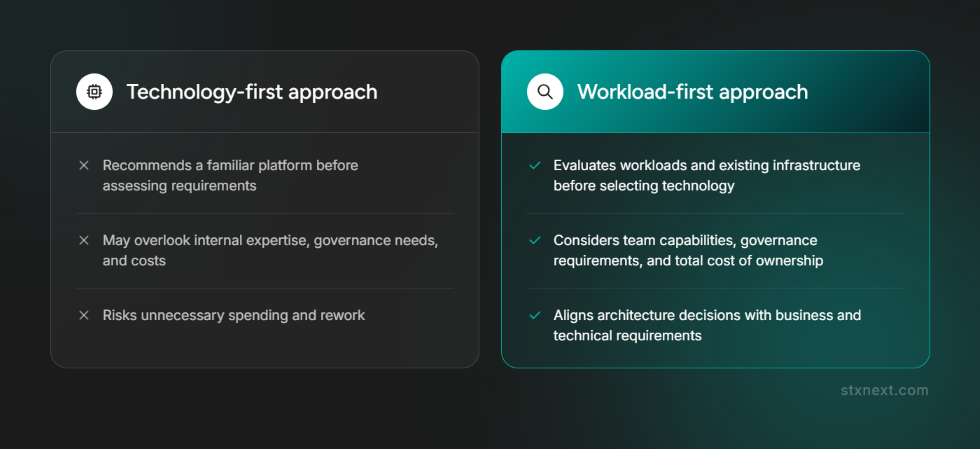
Two approaches to architecture planning
- Technology-first: The provider recommends a familiar platform before understanding your workloads, existing infrastructure, and technical constraints.
- Workload-first: The team evaluates workloads, current systems, internal expertise, governance requirements, and costs before recommending an architecture and migration approach.
A strong data engineering partner also validates critical assumptions before full-scale development. Discovery workshops are conducted to clarify business priorities and technical constraints, while prototypes or PoCs test uncertain aspects of the proposed architecture using representative data.
3. Data ingestion and integration: Balancing freshness, cost, and reliability
Consider a manufacturer collecting data from production lines. Daily production reports often rely on scheduled updates, but monitoring equipment conditions is different. If a machine's temperature approaches a critical threshold, operators need that information early enough to respond before production is disrupted.
Business and technical stakeholders have to agree on the required data freshness, balancing operational value, source system limitations, and processing costs. Engineers then select the appropriate integration patterns. The solution may combine several approaches:
- Batch processing: Scheduled transfers for workloads that tolerate delays.
- Change Data Capture (CDC): Capturing database changes without repeatedly extracting entire tables.
- Streaming: Continuous ingestion and processing of events for low-latency workloads.
- APIs and legacy connectors: Connecting applications with different interfaces, rate limits, and technical constraints.
Getting records into the system on time doesn't mean they're ready to use. Different identifiers, inconsistent formats, and late or out-of-order updates create problems when combining information from multiple sources. Engineers account for these differences when designing integrations so downstream systems receive records they can process reliably.
Pipelines also have to to recover from interruptions. If an API becomes unavailable or a transfer stops halfway through, engineers design retry and checkpoint mechanisms alongside duplicate handling so processing can resume without missing or double-counting records.
The provider's job is to deliver integrations that make the required information available when it's useful, keep records consistent across systems, and recover from failures without leaving downstream teams to correct the data manually.
4. Data transformation and modeling: Keeping business metrics consistent
Two dashboards show different operating costs for the same period. Which figure should you trust?
One includes costs that have been incurred but not yet invoiced, while the other counts only recorded invoices. Both draw on valid data, but their calculation rules produce different totals.
Changing the calculation in one dashboard won't prevent the same discrepancy from appearing elsewhere. A data engineering partner builds shared, tested transformations and models so reports and applications use the same agreed business definitions.
The work also involves deciding how information is organized. For operating costs, that could mean linking expense records to departments and reporting periods, preserving the detail required for analysis, and preparing summaries for management reporting.
Several techniques support this:
- Transformation frameworks: Tools such as dbt are used to build, test, and maintain reusable datasets with version-controlled transformation logic.
- Semantic models: Define business metrics and calculation rules consistently across reports and applications.
- Layered architecture: Separate raw records from refined and business-ready datasets, using approaches such as the medallion architecture.
If the company decides to include additional expenses in its operating costs, engineers update and test the shared logic. Reports and applications using that metric definition can then use the updated logic without requiring separate changes to each report.
5. Data quality and observability: Tracing errors to their consequences
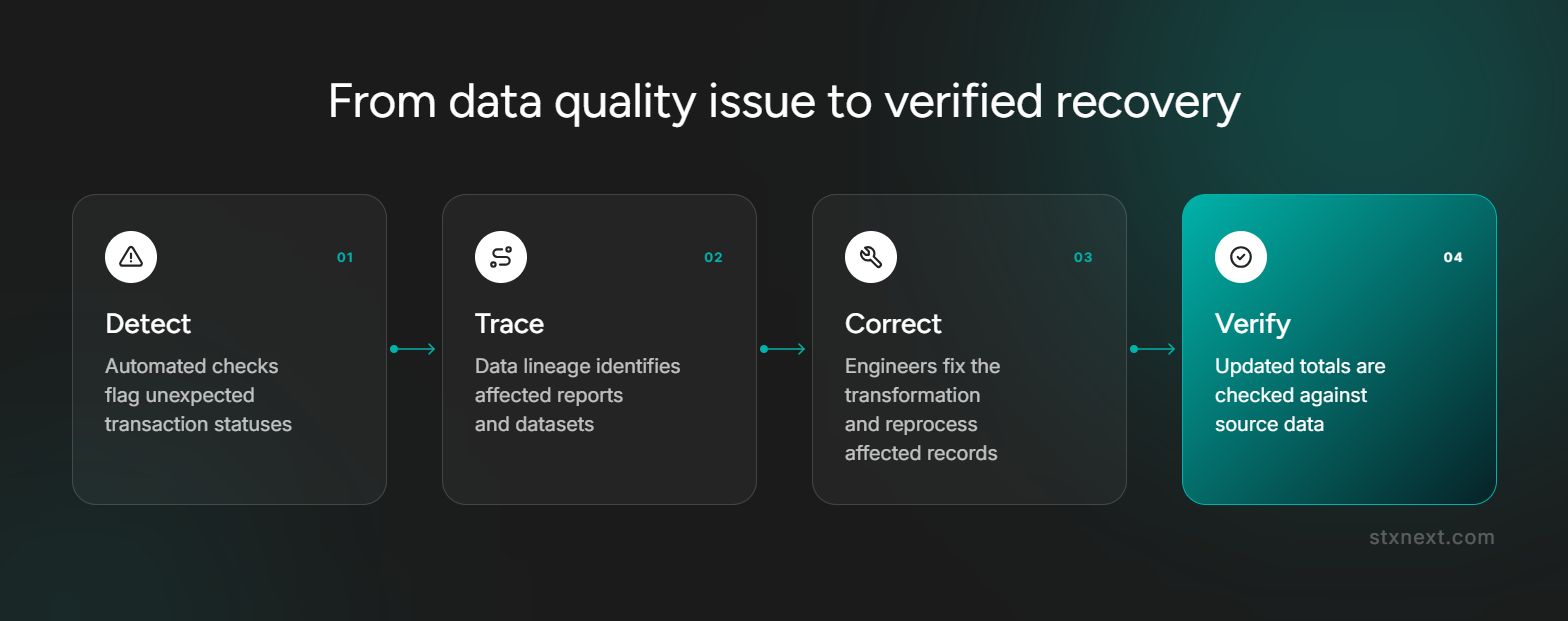
Automated tests tell engineers when something is wrong with the data. But a data engineering partner also has to establish which reports or applications are affected and how the problem will be fixed before incorrect figures reach business users.
That involves three areas:
- Detect: Implement automated checks for missing records, stale information, duplicates, invalid values, and unexpected schema changes.
- Trace: Configure monitoring, alerts, and lineage so engineers can investigate failures and identify affected datasets, forecasts, or applications.
- Recover: Define how failures are handled, including when to stop processing, hold back affected records, or reprocess data after correcting the issue.
Consider a financial reporting system where an upstream application changes how transaction statuses are recorded. The data still arrives, but an existing transformation no longer handles some values correctly, leaving the calculated totals incomplete.
An automated check flags the unexpected values, and lineage helps engineers identify which reports contain incomplete figures. The team then corrects the logic, reprocesses the relevant records, and verifies the updated totals against the source data.
6. Data governance and security: Turning policies into controls
Your customer data is available to finance, sales, and analytics teams. How do you give each group access to the information they need without exposing sensitive records?
Let's see an example - take an insurer combining policy, claims, and client data for management reporting. Analysts look for consistent figures across these systems, but that doesn't mean everyone should be able to see policyholder details or access individual claim records.
A data engineering partner translates those restrictions into technical controls. Role-based permissions determine who will access particular datasets, while column-level restrictions and masking protect sensitive fields. Data catalogs and documented ownership help teams understand what information is available, what it means, and who is responsible for it.
Where master data management fits
An ERP and CRM potentially maintain different identifiers or records for the same customer. Master data management (MDM) is then used to establish common definitions, match records across systems, and identify authoritative information.
These decisions typically involve business data owners and MDM specialists. A data engineering partner needs to account for the agreed definitions and matching rules when building integrations and transformations, so the differences between source systems don't carry through into reporting.
Tracing data back to its source
But access controls are only part of the work. When a reported figure is questioned, metadata and lineage let engineers identify its sources and understand the transformations applied. Audit logs provide records of relevant access and administrative activity.
The result is that teams are able to work with the same governed data without receiving identical permissions. New reports and applications use those datasets while respecting the restrictions already in place.
7. Production engineering: Reliable releases and scalable operations
What happens when a new transformation is ready or an existing pipeline requires updating? Releasing it doesn't mean manually changing configurations and hoping nothing breaks.
A data engineering partner puts a controlled process in place so updates are tested, reviewed, and approved before reaching production, then checked after deployment:
Code update → automated validation → review and approval → deployment → verification
CI/CD automates testing and deployment, while infrastructure as code (IaC) allows infrastructure configurations to be version-controlled and reproduced consistently across environments without relying on manual setup.
As workloads grow, the team monitors processing times, resource usage, and cloud costs to spot bottlenecks and decide where to optimize pipelines or increase capacity.
8. Knowledge transfer and ongoing operations: Establishing long-term ownership
Who maintains the data pipelines after launch? Who investigates failed integrations or approves changes to shared transformations?
These responsibilities often stay with the provider, but they may also be handled by your internal engineers, or shared between both teams.
Take an energy company collecting operational data from multiple sites. A change to one source system's API causes an integration to fail. The provider and internal team need an agreed process for investigating the failure, identifying affected reports, restoring the missing records, and verifying that processing has resumed correctly.
An end-to-end delivery covers two areas:
- Documentation and training: Shared code repositories, architecture diagrams, source mappings, model definitions, deployment instructions, and runbooks. Engineers also receive practical guidance on troubleshooting pipelines and making changes.
- Ongoing operations: Monitoring, incident response, maintenance, performance optimization, and production releases, with clear responsibilities across the teams involved.
The same applies when changes are planned rather than caused by failures. Updating a shared transformation involves approval from the business data owner, changes to dependent models, automated tests, and a controlled release.
Implementation expertise vs. end-to-end data engineering
A provider might be excellent at building pipelines or configuring cloud infrastructure. But would the same team determine where transformations belong, establish consistent business definitions, implement access controls, and manage production releases?
Delivering a complete solution calls for a broader range of skills. Here's how that differs from a more focused technical engagement.
The right delivery model depends on your internal capabilities. If your teams already own architecture, governance, and operations, a focused implementation engagement could be sufficient. Other organizations need broader support, from initial assessment and platform design through implementation and production handover. In either case, responsibilities should be clear, and the delivered solution maintainable by the team that ultimately owns it.
What makes a data platform production-ready?
Production readiness must be defined before implementation, with measurable acceptance criteria agreed between the customer and delivery team. Beyond working integrations and dashboards, the platform has to demonstrate that it can handle expected workloads, failures, access restrictions, and operational changes.
These capabilities are typically verified through tests conducted under realistic conditions.
Evidence includes: reconciled figures against source records, data arriving within agreed deadlines, recovery from interrupted transfers, and verified restrictions on sensitive information. Deployment and performance tests also demonstrate that the team is capable of restoring a failed release and handling expected processing volumes.
That gives you a basis for accepting the solution based on demonstrated behaviour, rather than simply confirming that the infrastructure and pipelines have been deployed.
What should your data engineering project deliver?
A successful data engineering project delivers more than infrastructure and pipelines. It provides validated data, clear operational ownership, and evidence that the platform works under realistic conditions. It ideally also leaves the organization able to maintain and extend the solution as its requirements evolve.
STX Next helps assess your existing data environment, identify engineering gaps, and define a practical delivery scope. Planning a new data initiative or modernizing an existing platform? Get in touch with us and let’s talk about your business goals and technical requirements.


