


Introduction
For technical leaders, the question is no longer whether to invest in AI, but who to partner with to make its implementation successful. Model selection, framework expertise, polished demos, and promises of rapid ROI are often easier to evaluate than the capabilities that determine long-term business value.
McKinsey’s State of AI 2025 found that only 39% of organizations attribute any EBIT impact to AI, while nearly two-thirds have not yet started scaling AI across the enterprise. Another of their reports shows that of the 25 factors tested, the redesign of workflows had the biggest effect on whether the organization saw bottom-line impact.
This suggests that the ability to identify high-value use cases, work effectively with existing data and systems, redesign business processes, and move solutions from pilot to production often has a greater impact on outcomes than the underlying model or tools.
An effective AI implementation provider needs to excel in these areas :
- Identifying which workflows are worth automating and which are not
- Building a reliable, clean data layer that integrates with legacy systems
- Transforming raw AI capabilities into a dependable business process
- Delivering enterprise software that runs reliably under real-world conditions
- Designing solutions that remain secure, compliant, and auditable
Criterion 1: Can the AI implementation company identify which workflows are worth automating?
Technical success doesn't guarantee business value. A team builds a predictive dashboard, a document classifier, or a customer chatbot. The software launches right on time and technically works perfectly.
Months later, the business impact is invisible. This happens because the automated process was never a major source of cost, delay, or operational risk. The investment targeted the wrong workflow.
Should you define your AI use case before choosing a vendor?
Quite often procurement guidance recommends defining use cases and success metrics before engaging a vendor. Problems begin when that first use case becomes a fixed requirement rather than a starting point for discovery.
This is exactly where a meaningful share of AI spending is lost. Teams often prioritize workflows that are highly visible and easy to explain but difficult to justify economically. Meanwhile, manual, fragmented processes that consume hundreds of engineering hours every month go completely untouched.
A capable provider treats the initial request as an opinion, not a final specification, and helps compare several candidate workflows before deciding where to invest.
Evaluate an AI partner's discovery process
The strongest AI strategy consulting and implementation processes combine workflow discovery, data readiness, software engineering, and adoption support. This is where AI stops being an experiment and becomes part of daily operational routines.
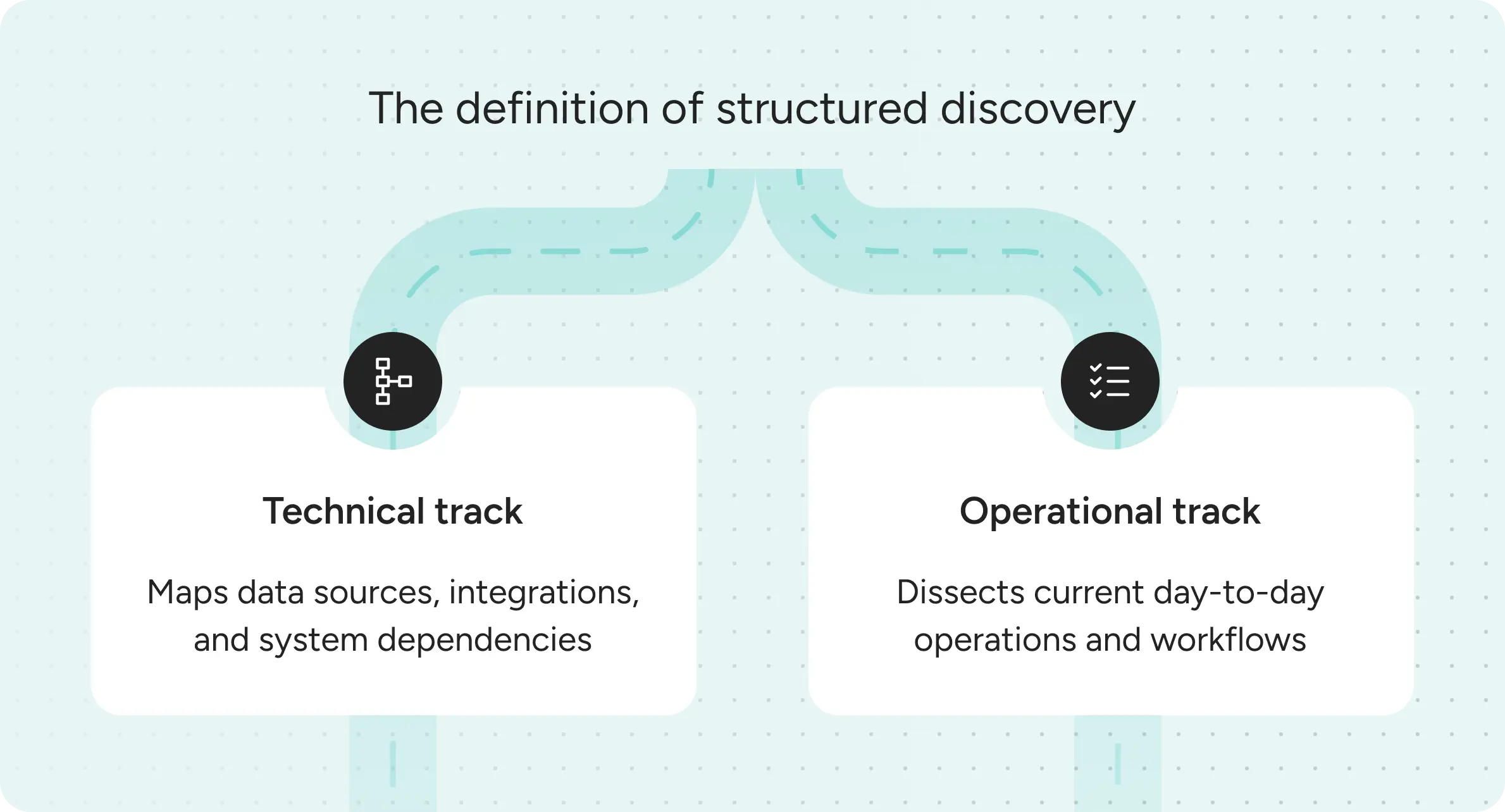
Discovery usually runs across two parallel tracks:
- Technical track: Architects and engineers map data sources, integrations, security requirements, permissions and dependencies between systems. This is where data readiness is assessed and major delivery risks are surfaced early.
- Operational track: Domain experts dissect your current day-to-day operations. Where do delays occur and which activities consume the most time? Which steps follow predictable rules and which require judgment? These questions help determine whether automation is tied to measurable business value.
A strong signal is when an AI partner can validate the idea through a focused PoC using a limited set of real business data.
If your team is still deciding which workflows are worth automating, an external discovery workshop can help compare use cases before budget is committed.
Such workshops are designed to help teams assess workflow value, data readiness, feasibility, and implementation risks before moving into delivery.
What to look for during discovery
Criterion 2: Can the company build and stabilize your data foundation?
AI projects routinely fail before reaching production because the underlying data layer isn’t ready. If an enterprise relies on fragmented information, siloed databases, or undocumented legacy logic, an AI model will simply reproduce those errors faster.
Simply put, building an application on an unstable foundation turns the deployment into a permanent data-cleaning problem.
Can they work with your existing data and legacy systems?
Listen for whether a vendor asks about source systems, APIs, identity and access management, data ownership, and the dependencies between older systems before they ever talk about models.
Engineering stable data pipelines
Look for a partner that provides data engineering services aiming to build and optimize the automated ingestion pipelines feeding the AI. A data-mature engineering team addresses these infrastructure issues first, focusing on cleaning and standardizing raw data fields so the information is accurate, governed, and properly formatted before it ever reaches the model.
Additionally, if your use case requires real-time alerts, they should demonstrate how to handle these live data streams and organize the layout without creating massive performance bottlenecks. The goal is to make sure the entire architecture runs natively on trusted, consistently structured information.
Criterion 3: Can the vendor turn AI into a working business process?
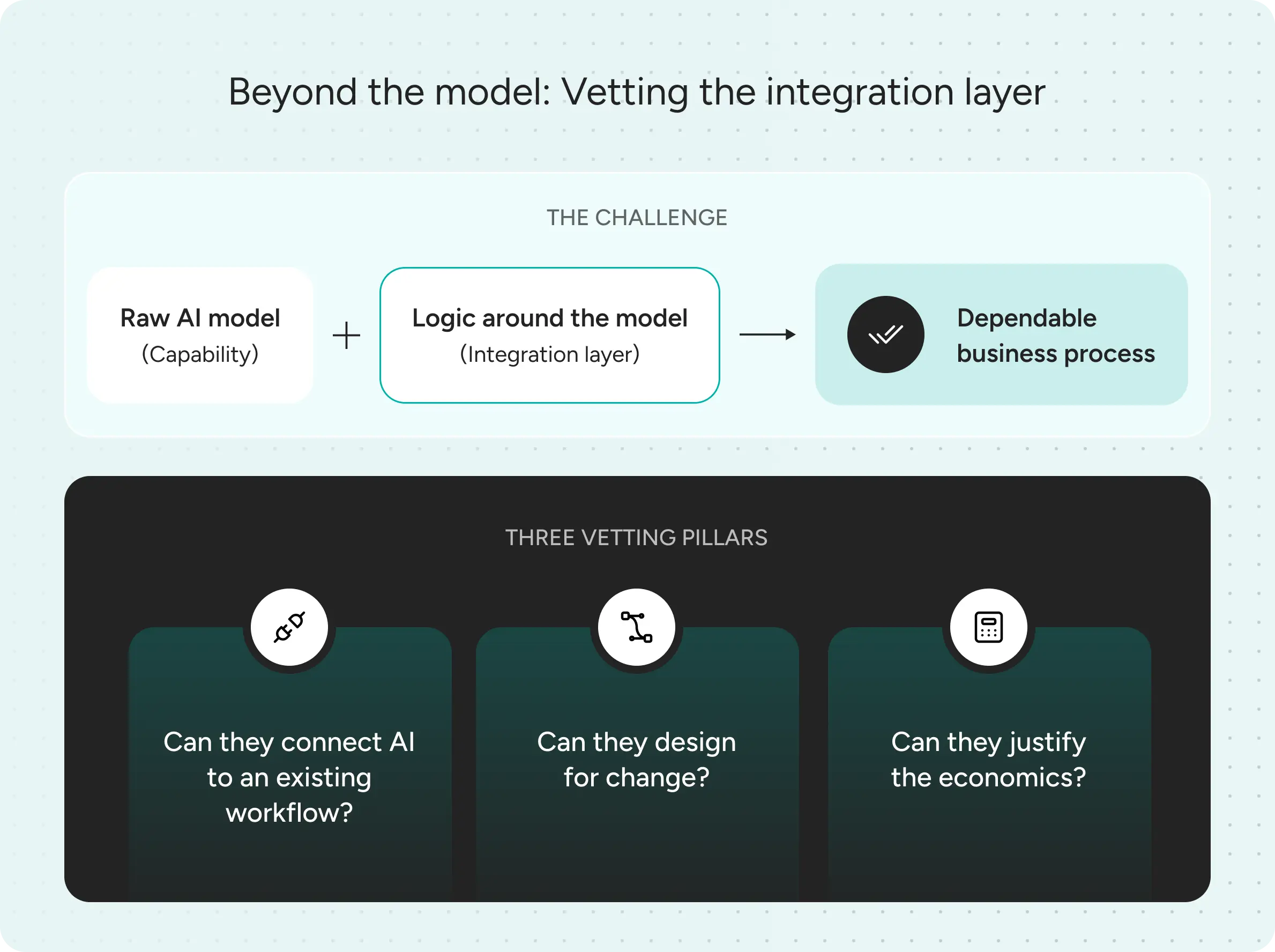
Plenty of vendors can demo a model that handles a specific task in isolation. The harder part is turning that raw capability into a dependable business process.
That means building the logic around the model - the code that syncs downstream systems, triggers human approvals, and routes edge cases to the right teams. Building a dependable process means focusing directly on that integration layer.
Here are three questions to test if a vendor can build beyond the model.
1. Can they connect AI to an existing workflow?
Isolated model performance says little about whether a solution can support your daily operations. Ask what happens after the model generates an output.
The team should be able to explain which system receives that information, whether it triggers an action automatically, who reviews exceptions, and how the process continues from there.
2. Can they design for change?
The business rules and systems connected to an AI solution will eventually change over time. New guidelines are introduced, connected systems are updated, approval paths alter, and exceptions appear that were never included in the original requirements.
The vendor should be able to explain how those variations affect the workflow and what mechanisms are in place to update the logic without breaking the underlying model.
3. Can they justify the economics?
It’s important to understand whether the economics work once the solution becomes part of day-to-day operations. Ask how the business case was built. You should get an explanation of the expected operating costs (like API and token usage), the assumptions behind the project savings, and how those numbers change as your business usage grows.
If the discussion focuses only on model performance and expected benefits, important parts of the implementation cost may still be unknown.
Criterion 4: Does the AI implementation company have software delivery experience beyond AI?
You will meet many vendors who excel at building impressive single-user prototypes but lack the foundational discipline required to run stable software in large, regulated enterprise environments.
This distinction is important because a company can, for example, demonstrate a model that summarizes contracts with impressive accuracy and still struggle to deploy it to 4,000 users, maintain audit trails, or support it after launch.
This is because speed in building a prototype does not equal enterprise readiness. While AI-assisted coding tools like Claude Code, Cursor, or GitHub Copilot can drastically increase raw development speed, they only help write code faster.
They don't remove the need for architecture reviews, rigorous testing, security controls, deployment processes, or operational ownership.
Partners with established engineering practices use these tools within their existing delivery process. The result is faster development without sacrificing maintainability, reliability, or visibility into how the system works.
For a deeper look at this delivery model, see STX Next’s approach to AI-augmented software development.
To avoid getting trapped with an unmaintainable demo, look past the AI experimentation layer and audit their engineering maturity against these requirements:
- Engineering heritage: Teams that have spent years delivering enterprise software tend to talk about deployment pipelines, rollback procedures, testing strategies, integration patterns, and ownership models. Ask about systems that have been running for several years.
- Retrieval integrity: In retrieval-based systems, ask how the solution handles document updates, multiple languages, duplicate content, and access controls.
- Production operations and handoff: A demo proves a model can work once under controlled conditions. Enterprise-grade operations require built-in MLOps practices such as automated testing, incident response procedures, and security standards. Enterprise-grade deployment requires designing for clear ownership boundaries.
How can you tell production engineering from experimentation?
Look for a partner whose portfolio shows long-term application stability rather than just isolated prototypes. A mature engineering track record includes building high-volume data platforms or secure enterprise retrieval tools for global companies. If their case studies only feature standalone pilots running on static datasets, they are likely still experimenting.
Criterion 5: Can the partner design an architecture that is secure and compliant for the organization?
Security requirements don’t disappear when AI is added to a system. In many cases, they become more complicated. Enterprise AI may introduce an attack surface that traditional security controls were not designed to address.
A deployment can't be considered secure for your organization if it introduces compliance risks, compromises data sovereignty, or creates an un-auditable legal liability.
A solution may pass a conventional IT security check and still expose proprietary corporate IP, violate regional data privacy laws, or operate without sufficient operational visibility under the hood.
When discussing the choice of a consultancy, look for answers across these two dimensions - corporate compliance and application-level controls:
- User inputs: How does the AI application handle unexpected, misleading, or malicious input? What controls prevent users from accessing information or triggering actions outside the intended scope? Look for safety boundaries that stop prompt injection attacks from tricking the application into bypassing its rules.
- Access to information: How are permissions enforced when the AI solution retrieves information from internal documents, legacy databases, or business applications? Access must be checked dynamically at the moment of retrieval, ensuring a user can't see files they don't have corporate clearance for.
- Actions and integrations: If the AI application can create tickets, update records, trigger workflows, and interact with other software, ask how those actions are controlled. Look for least-privilege permissions, verification steps before high-impact or irreversible actions, and hard boundaries around what the solution can and cannot execute.
- Monitoring and auditability: Visibility is a security control. Ask what telemetry is collected from the AI application, how activity is monitored, and what happens in audit logs. Technical teams should be able to track exactly which source documents were referenced, what actions were taken, and whether behavior changes over time.
- Compliance and data sovereignty: Does the partner hold verified standards like company-wide ISO/IEC 27001 or TISAX certifications? Can they deploy natively within private clouds or virtual private networks (VPCs) to keep proprietary data strictly under your legal jurisdiction?
It’s a good idea to ask the candidates to walk through a single user interaction from beginning to end, mapping every check that occurs at each layer. A solid answer explains what happens at each stage. Teams that can describe all controls in detail usually treat security as a built-in part of the system architecture rather than a superficial patch.
The final filter: Do you even need an external partner?
Sometimes the honest answer is that you don’t need one at all. This is usually the case when:
- A single, stable task is all you need automated, and it will not change month to month.
- The data already sits in one clean system, rather than spread across legacy systems and acquired databases.
- Your own engineers can own the deployment, monitoring, and retraining and have time to do it. The system stays away from regulated data, so you can rely on basic access control and standard logging rather than designing a bespoke compliance regime.
Whether you run this scoping phase internally or with external support, the goal remains the same. You have to look at engineering maturity rather than vendor sales pitches. If a proposal focuses entirely on model benchmarks while skipping over your legacy technical debt, the project will likely stall after the pilot phase.
To avoid that, a realistic assessment needs to evaluate the initiative against foundational criteria, treating data readiness, workflow integration, and architectural governance as strict requirements before code is written.
How to choose the right AI implementation partner: the takeaway
The easiest things to compare (model counts, framework names) tell you the least about whether the project will work. What predicts success is whether the team can pick the right workflow, build automation that survives change, run software in production, and secure it.
None of it shows in a demo, which is why projects stall after launch.
The clearest signal is behavioral. Potential partners ask difficult questions, challenge assumptions and spend time understanding your systems and constraints before discussing delivery timelines. They’re willing to narrow the scope or recommend a different approach when the original idea doesn’t hold up.
If you’re comparing AI implementation consultancies today, those are the capabilities worth evaluating. They’re also the principles that guide STX Next’s approach to enterprise deployment, from identifying the right opportunities to building, operating and securing systems in production.


