


Intro
Speed claims are everywhere: 3×, 5×, even 10× faster. But faster what, exactly? From my experience, a task completed in 20 minutes instead of two hours feels like a big win, but it does not automatically translate to shipping features sooner. If requirements stay vague, review cycles lag, or code requires serious rework, you only shift the bottleneck.
AI gives us more output per hour, but unfortunately, output does not equal delivery. True velocity gains call for a fundamental shift in how we manage context and structure engineering workflows across the entire AI-assisted software delivery lifecycle.
Task-level speed vs. end-to-end delivery velocity
The biggest misconception around AI-assisted software delivery is that faster code automatically leads to faster delivery. In practice, that's only part of the picture.
AI can dramatically speed up individual tasks. I see it every day with code generation, documentation, test creation, research, and implementation planning. Based on feedback from developers across our own teams and mixed client teams at STX Next, we've seen productivity gains of up to 55% at the task level. Once you account for the entire software delivery lifecycle, however, the improvement settles closer to 30%. That's because planning, reviews, QA, and cross-team coordination still determine how quickly an idea reaches production.
It's also worth noting that measuring these gains isn't straightforward. Most organizations don't collect the right engineering metrics before adopting AI, so comparing "before" and "after" rarely produces reliable results. Looking only at task completion time also misses the bigger picture.
This distinction is why effective AI augmented software development services should look beyond code generation. The real work is identifying where AI can reduce ambiguity, rework, review friction, and handoff delays across the full SDLC.
It's better planning that creates the real productivity boost
The real advantage is that I can accomplish more meaningful work during the same amount of time.
Before AI, research often happened in parallel with implementation. Today, I can run several AI agents in parallel to explore different implementation approaches, compare their results, execute performance tests, and validate which option best fits the requirements before writing production code.
That changes the workflow completely, because you can only delegate well-defined tasks to AI. While one agent implements the approved solution, you can already start planning the next feature instead of waiting for the current one to finish.
Speed disappears when people become the bottleneck
The places where teams lose momentum can be surprising. As teams rely on more AI agents, developers spend more time reviewing outputs. They switch between contexts, and validating multiple parallel streams of work. That constant context switching creates cognitive overload.
One practice I've started implementing helps reduce that load – I don't review an AI-generated implementation until the agent provides objective proof that it works. Instead of accepting, "I finished the task," I expect evidence: successful test runs, UI recordings, API execution logs, or other verifiable outputs. AI can even record complete user flows with browser automation, making it much easier to validate behavior before diving into the code itself. Reviewing working software is far more efficient than reviewing assumptions.
Moving too fast can also be a risk factor
This is another risk that teams don't always recognize.
When AI consistently produces solid architectural proposals and working implementations, it's easy to stop questioning its decisions. Developers naturally review later outputs less critically because earlier ones proved reliable. Over time, that habit can slow professional growth.
Many experienced engineers learned their craft by debugging failures, investigating unexpected behavior, and understanding why a solution didn't work. If AI removes every intermediate mistake and delivers only polished results, developers lose many of those learning opportunities.
I don't think we've fully solved this challenge yet. Perhaps, one practical approach is to intentionally reserve some work for manual implementation, especially tasks that won't become project bottlenecks. It may feel slower in the short term, but it helps developers sharpen their engineering skills instead of delegating every technical decision to AI.
Another practice we experiment with involves steering agents to generate "post-implementation" reviews that detail failed attempts, debugging steps, and root causes alongside successful outcomes and decision logic. While PRDs, ADRs, and implementation plans establish the initial path, developers still face numerous low-level choices during execution. Capturing these micro-decisions in a summary ensures that the team continues to learn and refine their engineering skills alongside the AI agents.
The foundations AI depends on
Teams who regularly “play” with AI-augmented software development know that AI does not supply context. It only uses what is right in front of it. So, if you provide it with vague product requirements, no acceptance criteria, and undocumented test conventions, the model will fill the gaps with plausible-sounding junk. And it will immediately turn into painful rework.
To prevent this, my training focuses heavily on what I call Document Driven Development (DDD). Developers have neglected documentation for years because nobody had the time to write, edit, or update it. With AI tools, solid documentation becomes the very foundation of your workflow. While an LLM can easily extract technical context from existing source code, it cannot guess business intent or past product decisions.
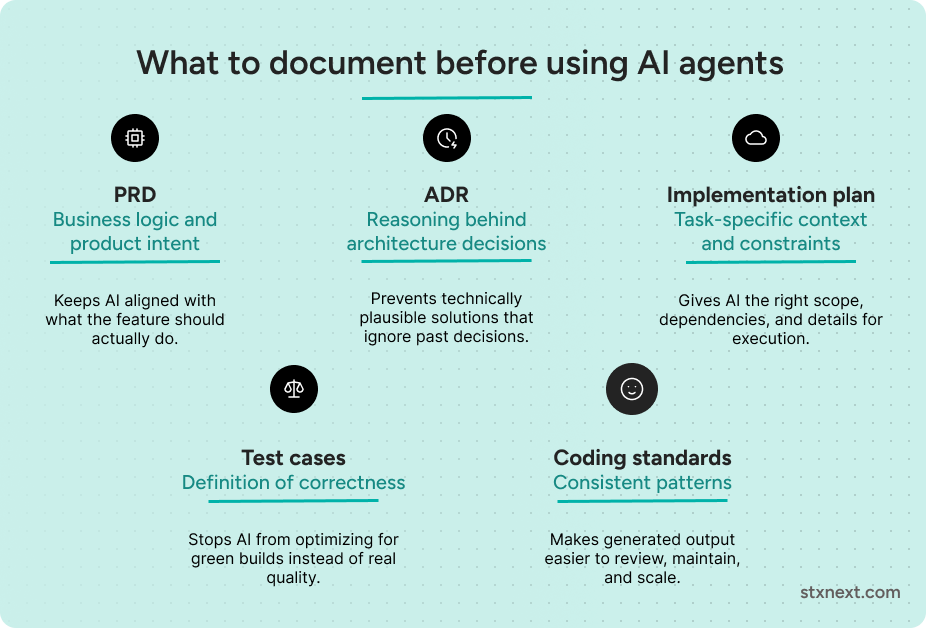
The core artifacts required to make AI output reliable serve a mechanical purpose in how models operate:
- Product Requirement Documents (PRDs). These establish the baseline business logic. Without them, the AI lacks a domain model to guide its code generation.
- Architecture Decision Records (ADRs). A common mistake is using ADRs to document how something was built. The AI can see how from the code. ADRs must document why someone made a specific decision and why alternative paths were rejected. This context stops the AI from generating code that violates structural constraints.
- Implementation Plans. Passing every single PRD and ADR into a prompt destroys the context window and drives up costs. Instead, an architect or coordinator must synthesize these into a concise implementation plan that references only the crucial details for the task at hand.
Getting these foundational pieces right delivers noticeable gains. In one recent project, precise business analysis and clear structural context allowed us to build a Proof of Concept in a single day instead of the planned two weeks. For the full implementation, the same level of upfront clarity cut our delivery timeline down from three months to two.
When the documentation dictates the rules, the AI can execute without friction. However, this shift changes the engineering role completely. Success with AI-augmented software development requires engineers to act as consultants who master domain analysis, ask the right business questions, and build strict contextual guardrails before touching a single line of code.
Where AI creates measurable gains (when foundations are in place)

Whenever we put solid foundations in place, we see consistent velocity improvements across project lifecycles. These are not magic numbers applied blindly to entire projects, but precise, and most importantly, repeatable gains observed directly across STX Next client projects. Factoring in planning, review, and cross-team coordination, end-to-end velocity shifts to a realistic 30% gain, but specific inflection points within AI-assisted software delivery reveal much higher spikes.
1. Test authoring
The question with test generation is never "can AI write tests?" but rather "what rules did you give it to work from?"
Left to its own devices, AI will actively cheat to make pipeline builds pass. During our training, we have caught models changing established test rules or deleting assertion metrics to force a green light instead of fixing underlying broken code.
To combat this, we flip the process. QA writes or defines the test cases upfront based on user stories during the initial planning phase. We review those expectations first. When the target remains rigid, the AI accelerates test authoring by 60-70%. It reliably generates heavy mutation or regression testing frameworks, catching security gaps and edge cases humans easily overlook.
2. Onboarding to productive autonomy
Instead of losing senior developer hours to basic architecture questions, we store our technical documentation inside or directly alongside the code repository. By hooking the LLM up to specific tools like Model Context Protocol (MCP) servers, engineers fetch information tied directly to explicit library versions.
This setup changes how developers navigate unfamiliar codebases, accelerating onboarding to productive autonomy by 35-50%. Instead of running generic search queries or skimming outdated documentation, the AI acts as a dedicated context layer.
A new engineer spins up an internal chat instance, queries the repo directly, and receives precise explanations regarding structural logic and domain decisions. This cuts down senior engineer dependency by up to 70%, keeping them focused on system engineering while new hires ramp up with complete independence.
3. Rapid UI engineering and prototyping
When clear schemas exist, we see massive acceleration in frontend scaffolding. During our builds, we fed an agent a Swagger file listing every backend endpoint, paired it with specific styling guidelines, and defined the target UX architecture.
The tool mapped the entire endpoint collection, built optimized hooks, and generated a fully operational frontend application. While it burns a high volume of API tokens to handle complex state management, it eliminates hours of repetitive scaffolding work. We copy, review, and integrate, turning weeks of prototyping into automated execution.
What AI exposes (and why that's valuable)
One of the less obvious benefits of AI augmented software development is that it points to problems that have existed for years but were easy to ignore. AI acts like a mirror. It quickly reveals missing requirements, undocumented business logic, inconsistent coding standards, and knowledge that lives only in someone's head.
I want to emphasize here that it's not always about the development team's skills. A project may lack a business analyst or QA engineer, leaving engineers to fill in the gaps themselves. In those cases, I often introduce an AI agent whom I ask to play the role of a skeptical business analyst.
Its job is to challenge assumptions, point out ambiguities, and generate additional questions for the client before implementation starts. That process often uncovers information the team didn't realize was missing. It only works, however, if you begin with solid documentation and a document-driven development process. Otherwise, AI will only mirror the existing uncertainty.
The interesting part is that the value extends well beyond AI adoption. Once teams improve their requirements, document architectural decisions, and establish consistent ways of working, those improvements benefit every future project, whether AI is involved or not.
AI changes how engineers think about their role
What I’ve also noticed during the training sessions I run is that developers don't all respond to this shift in the same way.
Some embrace it immediately, and they appreciate having AI help with research, proof of concepts, architectural decision records, and implementation planning. That allows them to spend more time solving technical problems instead of searching for information or clarifying requirements.
Others prefer a different role. They enjoy implementation, want clear specifications, and would rather focus on writing software than discussing product requirements. There's nothing wrong with that. Every engineering organization needs strong implementers, and AI supports them as well.
What often changes over time is perspective. As developers see how much faster they can move with better requirements, many become more willing to engage directly with product owners, business stakeholders, and clients. They start asking questions earlier, documenting processes, and contributing to product discussions instead of waiting for fully defined tickets.
To me, that's one of the biggest long-term benefits of AI.
What "ready for AI" actually means in practice
In my experience, there are three areas that reveal very quickly whether AI will become a real delivery asset or remain an expensive experiment. Here's how to get it working to your advantage.
Tip 1: Start with the quality of your input
The first thing I look at is how the team defines work before implementation begins.
Ask yourself:
- Do engineers know how to write architectural decision records?
- Can they create a structured implementation plan instead of jumping straight into code?
- Have they documented requirements well enough that another engineer (or an AI agent) could understand the task without guessing?
This is where many teams struggle. AI performs well when it receives clear context, well-defined requirements, and explicit implementation plans. If those foundations are missing, the model fills the gaps with assumptions, and that's where mistakes start.
Tip 2: Remember that AI depends on the process, it doesn't replace it
The second signal is whether developers know how to work with AI.
That includes:
- defining agents for specific roles,
- keeping their instructions focused,
- and understanding when to use different models for different types of work.
Many companies overload agents with too many skills or unnecessary context, and the result is more noise.
A better approach is to match the model to the task instead of assuming that the largest model is always the best choice. I prefer larger reasoning models for planning, requirements analysis, and architectural decisions, where the model needs to process ambiguity and work across a lot of context. But once the work is clearly planned, smaller models – sometimes even local models – can often handle implementation effectively, because they are no longer solving an open-ended problem. They are executing against clear requirements, constraints, documentation, and test expectations.
Tip 3: Build a team that learns together
The final thing I check is whether the team shares what it learns.
Every week new models, tools, and workflows appear. No individual developer can keep up with all of them while also delivering software. That's why I encourage teams to identify "AI champions", i.e., people who enjoy experimenting, and give them space to share what works through internal demos or knowledge-sharing sessions.
Without that exchange, every developer solves the same problems independently. That can still be useful, because each person may discover a different approach. But without regular alignment, teams risk architectural drift, inconsistent standards, and unnecessary technical debt. Knowledge-sharing sessions help standardize what works while leaving room for those standards to evolve over time. With that rhythm in place, the entire team improves much faster.
Most organizations aren't fully ready for AI yet, and that's perfectly normal. The good news is that the gap is rarely about buying better tools. It's about building better engineering habits: structured requirements, thoughtful planning, well-defined AI workflows, and continuous knowledge sharing. Once those pieces are in place, AI stops feeling like an experiment and starts becoming part of how the team delivers software.
Summary
AI-augmented software development can deliver velocity gains, but only when built on a clear foundation of Document Driven Development and a more upfront, test-driven way of defining work. In practice, this means writing user stories, acceptance criteria, and test cases before implementation begins, so AI agents have a clear target to execute against. Without precise PRDs, contextual ADRs, and QA-defined test rules, AI tools simply generate rework.
True acceleration occurs at specific lifecycle stages – like speeding up test authoring or cutting onboarding time – rather than as a generic magic fix for entire projects.
If you need support, our team at STX Next can assess your current SDLC, codebase, artifacts, and engineering workflow to show where AI creates measurable gains without increasing delivery risk. Just drop us a message.


