



Introduction
For many European organizations, choosing an EU cloud region used to close the sovereignty discussion. If the data stayed in Europe, the setup was often considered safe enough from a compliance, security, and procurement perspective.
That assumption no longer holds for every workload.
As cloud platforms move closer to core business operations, data strategy, and AI adoption, the relevant questions have become more specific. Who can access the environment? Which legal system applies? Where is metadata processed? What happens if supplier, regulatory, or geopolitical risk increases?
This is why sovereign cloud has moved from a specialist public-sector topic to a practical decision point for European companies.
In most organizations, the answer won’t be to move everything into a sovereign environment. The better approach is to understand which workloads need stronger legal, operational, and technical control, and where standard cloud safeguards are already sufficient.
This article explains what sovereign cloud means in practice, why it matters now, which models are available in Europe, and how to decide where this level of control is worth the added complexity.
What is a sovereign cloud?
A sovereign cloud is a cloud environment designed to keep data, operations, access, and legal control within a defined jurisdiction.
In Europe, this usually means reducing exposure to non-EU legal systems, foreign government access requests, global support models, and long-term dependency on non-European technology providers.
At a practical level, the sovereign cloud is a combination of technical, operational, legal, and organizational controls. When organizations start evaluating sovereign cloud options, they usually discover that sovereignty has several layers.
Data residency vs. data sovereignty
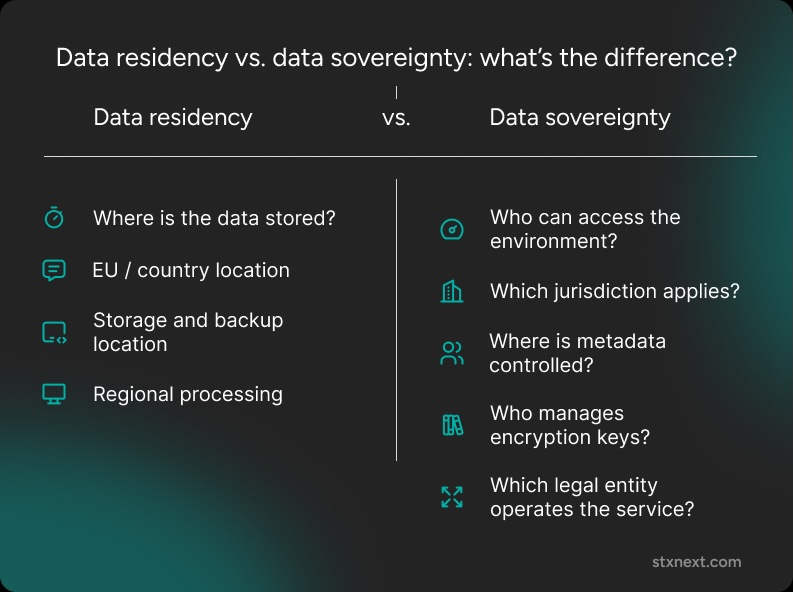
Data residency and data sovereignty are often used interchangeably, but they answer different questions.
Data residency tells you where the data is stored. Data sovereignty defines who controls the environment around it: jurisdiction, operational access, metadata, key management, and legal entity exposure.
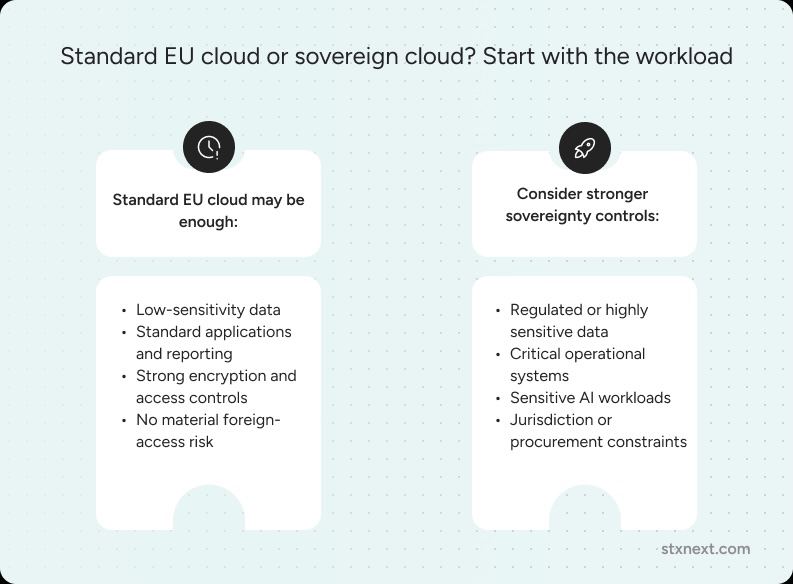
For many workloads, EU residency plus strong encryption, access control, and contractual safeguards may be enough. The threshold changes with regulated data, sensitive AI datasets, industrial process data, or systems where foreign legal access would create material risk.
Then the question is whether the full operating model meets the required level of control, not only whether the data sits in the right region.
What changed in Europe
Several things changed at the same time.
First, regulation became more practical. GDPR is still the baseline, but DORA has pushed financial institutions to look more closely at third-party ICT risk, resilience, and cloud dependency. NIS2 is doing something similar for manufacturing and other critical or important sectors, where cloud architecture is now part of the cybersecurity conversation.
Second, cloud platforms moved closer to the core of the business. They no longer support only websites, reporting, or back-office systems. They may now run production analytics, connected products, supply chain data, fraud detection, clinical analytics, industrial data platforms, or AI workflows.
That changes the risk profile. And AI is where this often becomes most visible.
Why AI workloads need a clearer sovereignty boundary
AI is often the moment when sovereignty becomes a practical blocker.
Your use case may be solid, and the business case may be clear. But if legal or security teams can’t approve how the data moves through the system, the project will struggle to reach production.
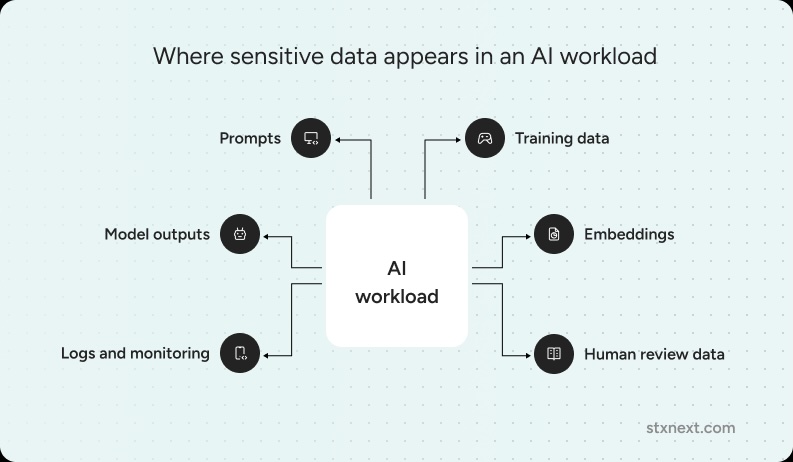
The sensitive data isn’t always only in the training set. It can show up in prompts, embeddings, outputs, logs, human review, and monitoring data. In manufacturing, that might include sensor streams, defect images, maintenance notes, production parameters, or supplier data.
A sovereign cloud gives you a clearer boundary for deciding where that data is processed, who can access it, how it is logged, and how the setup can be audited.
Common sovereign cloud use cases
In financial services, that usually means systems connected to customer data, payments, fraud detection, risk models, regulatory reporting, or AI-assisted decisioning. In healthcare and life sciences, it is more often patient data, clinical analytics, research datasets, medical records, or AI systems used for diagnostics and document processing.
Manufacturing is slightly different. The strongest case appears when cloud platforms expose operational know-how or support critical production decisions. Predictive maintenance, industrial IoT, quality analytics, computer vision, digital twins, energy optimization, production planning, supplier data platforms, and AI models trained on sensor streams or defect images can all reveal how the factory actually works.
Public sector and public-sector-adjacent projects are another natural fit, especially when procurement rules, citizen data, classified information, resilience, or vendor independence shape the decision.
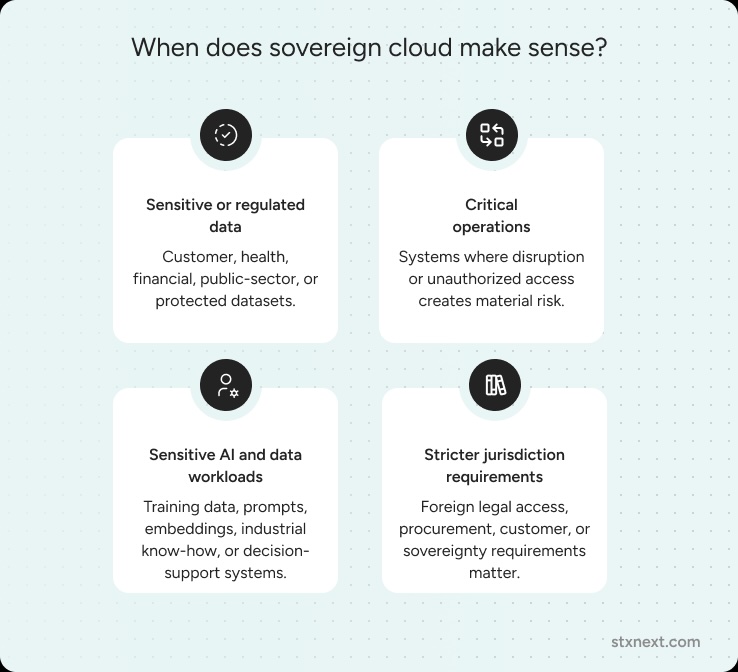
Across all industries, AI and data platforms deserve a separate check, especially when sensitive internal data is used for training, retrieval, fine-tuning, or decision support.
Where sovereign cloud can create unnecessary complexity
A sovereign cloud should be applied selectively. It gives you more control, but it also adds cost, migration effort, operational overhead, and possible service limitations.
It’s usually not needed for public websites, marketing pages, standard collaboration tools, generic internal dashboards, low-risk reporting, development sandboxes, or applications that process only non-sensitive operational data. A standard EU region with strong encryption, access control, logging, key management, and contractual safeguards will often be enough.
It can also be a poor fit when the workload relies on managed services that are not available in the sovereign environment. If moving the system means a large redesign with limited risk reduction, it’s usually better to strengthen controls where the workload already runs.
The point is to avoid both extremes: treating standard cloud as sufficient for every workload, or treating sovereign cloud as the default for everything.
The main sovereign cloud options in Europe
European organizations can choose from several sovereign cloud models, from stronger controls within an existing hyperscaler ecosystem to locally operated or European-owned platforms.
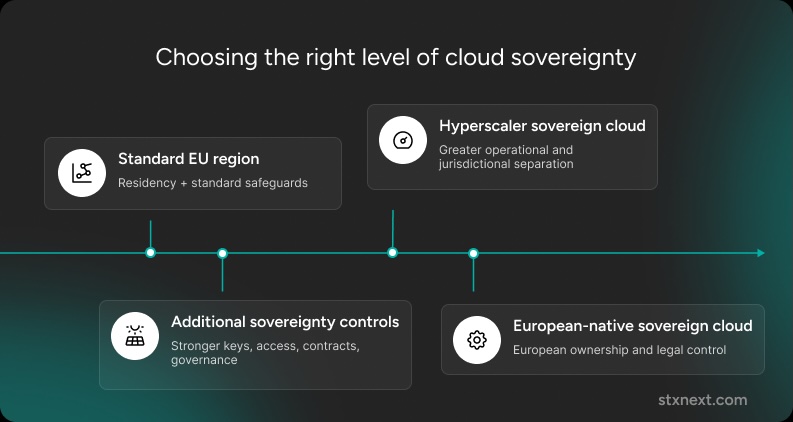
A hyperscaler sovereign environment, such as AWS European Sovereign Cloud, is useful when you want stronger European controls without leaving the ecosystem your teams already know. The main benefit is continuity: familiar tools, skills, APIs, DevOps practices, and operating models. The trade-off is that you still need to review service availability, control plane design, governance, legal structure, and migration requirements carefully.
Microsoft Sovereign Cloud offers several deployment models rather than one sovereign environment. These include additional sovereignty controls within Microsoft’s public cloud, private cloud options for workloads that need more infrastructure control, and locally operated partner clouds for specific national or public-sector needs. It’s most relevant to organizations already using Azure, Microsoft 365, or Power Platform. However, the services available, the way each environment is operated, and the level of separation from Microsoft differ between options, so each model needs to be assessed separately.
A European-native sovereign cloud provider, such as STACKIT or CloudFerro, is usually considered when European ownership, clear jurisdiction, portability, or open-source foundations matter more than access to the broadest managed-service catalog. The trade-off is that engineering teams may need to do more of the day-to-day platform work themselves. This can include database upgrades, observability, integrations, backups, disaster recovery, and AI tooling. That additional work should be included in the total cost of ownership, as it can increase both the initial implementation effort and the ongoing cost of maintaining the environment.
Standard cloud, hyperscaler sovereign cloud, or European-native provider?
Standard EU cloud regions are still the right fit for many workloads. The question is whether EU residency and standard controls are enough, or whether the workload needs stronger legal, operational, and technical control:
In practice, many organizations will use more than one model: standard regions for general workloads, a hyperscaler sovereign tier for selected sensitive systems, and a European-native provider where jurisdictional clarity or portability matters most.
This approach makes it possible to match the level of sovereignty to the risk profile of each workload, but it also adds operational and cost complexity. Identity and access management, security policies, monitoring, and governance need to work consistently across environments. Moving data between providers may also generate egress fees, while different pricing models can make total cloud costs harder to predict.
How to decide whether sovereign cloud is right for you
Start with the workload, not the provider.
The key questions are practical:
- What data does this workload process, and how sensitive is it?
- Which regulations, contracts, procurement rules, or customer expectations apply?
- Would foreign legal access create material legal, commercial, reputational, or operational risk?
- Is EU data residency enough, or do you also need control over operations, metadata, keys, support access, and legal entity exposure?
- Does the workload depend on services that are available in the target sovereign environment?
- Would migration improve the risk profile enough to justify the cost and complexity?
- Do you need portability or an exit strategy based on open standards?
If the answers point to regulated data, sensitive AI, industrial know-how, critical operations, or strict customer and public-sector requirements, sovereign cloud is worth assessing seriously. If the workload is low-risk and already well controlled, standard EU cloud may be enough.
Next steps
Start with identifying which systems handle sensitive data, map how that data moves through storage, processing, logs, backups, AI pipelines, and support workflows. Define what level of control is actually required.
From there, compare provider fit against architecture dependencies, service availability, migration effort, operating model, and long-term strategic control.
At STX Next, our sovereign cloud consulting team can help you assess which workloads need stronger control, which provider model fits best, and what migration effort to expect before committing to the architecture.
If you are trying to decide whether a sovereign cloud makes sense for your organization, contact our cloud team to review your workload, risk profile, and provider options.


