


TL;DR:
STX Next approaches AI discovery by starting with the workflow, not the technology, to determine whether AI, simpler automation, or process redesign is the right answer.
- Candidate use cases are evaluated against business impact, process maturity, data quality, infrastructure readiness, and implementation cost before development begins.
- Security, access permissions, compliance requirements, and human oversight are defined early so the level of automation matches the risk of the workflow.
- Representative data and working prototypes help validate the proposed approach before committing to full-scale engineering and production deployment.
Introduction
Across industries, leadership teams face immense pressure to deploy AI, whether to cut operational overhead, modernize legacy systems, or simply keep pace with competitors. Many organizations have already launched initial AI pilots, only to find they stall out, produce unreliable outputs, or fail to scale beyond simple experiments.
The problem is often not the technology itself.
Companies may attempt to automate workflows that are inconsistent or poorly defined, proceed without representative data, or pursue full autonomy where human oversight would be safer and more economical. In many cases, AI is not even needed. When a workflow follows fixed, rule-based logic, simple deterministic automation flows can work far more reliably and cost 10 to 50x less.
At STX Next, we begin by examining the underlying business process, its potential value, data readiness, organizational constraints, and implementation risks. We also review day-to-day employee workflows to identify adoption barriers and define the right level of human oversight.
Before full-scale development, we establish if AI is the right fit, consider if deterministic automation would work better, and clarify what would be required to implement it securely and reliably.
Here is how we evaluate AI automation opportunities and turn promising concepts into practical implementation plans.
Identifying and qualifying candidate workflows
AI implementation starts by identifying a concrete operational problem. Before choosing models, or architecture, teams need to understand which processes cause delays, errors, rework, or bottlenecks and why.
Few organizations begin with a clear, prioritized list of AI use cases. More often, teams know which parts of their operations are causing delays, high costs, or scaling problems, but need help deciding which are the strongest candidates for automation.
Discovery starts by breaking those operational problems down into specific workflows, decisions, and manual steps that could potentially be improved or automated.
We also look for capabilities that don’t exist today because delivering them manually would be too complex, time-consuming, or expensive.
Candidate workflows are then assessed using both day-to-day process issues and measurable performance data, including transaction volumes, cycle times, unit costs, and rework caused by manual errors.
This helps determine which workflows are suitable for automation, which need to be improved first, and where the expected gains are large enough to justify the effort.
Early discovery engagements range from a short alignment call to a multi-day workshop. These sessions are led by STX Next product consultants and Forward Deployed Engineers, speaking with people across different departments to understand daily operations. To steer clear of abstract technical discussions, discovery focuses on practical operational questions, such as:
- When a customer onboarding form arrives with missing or inconsistent information, which fields does an employee need to check manually, and what happens when the data can’t be verified?
- When a purchase request requires approval from a specific role and that person is unavailable, does it remain in a queue, get reassigned, or move outside the system through email or another workaround?
- If employees spend several minutes switching between systems, copying the same information, or checking every item on a screen, could a simpler interface or workflow remove those steps without introducing AI at all?
Working through these operational questions first prevents an organization from spending months building software around a process that was never going to work well, automated or not.
In fact, this is usually the moment clients realize the main blocker isn't what they feared. Teams often come into discovery worried about bandwidth, system lag, or whether the technology is just too complex to implement.
But as we break down the workflow, the real question becomes much simpler: how do we help employees make faster, more accurate decisions on screen? Once the focus shifts from technical limitations to the decisions employees need to make, the requirements become much clearer.
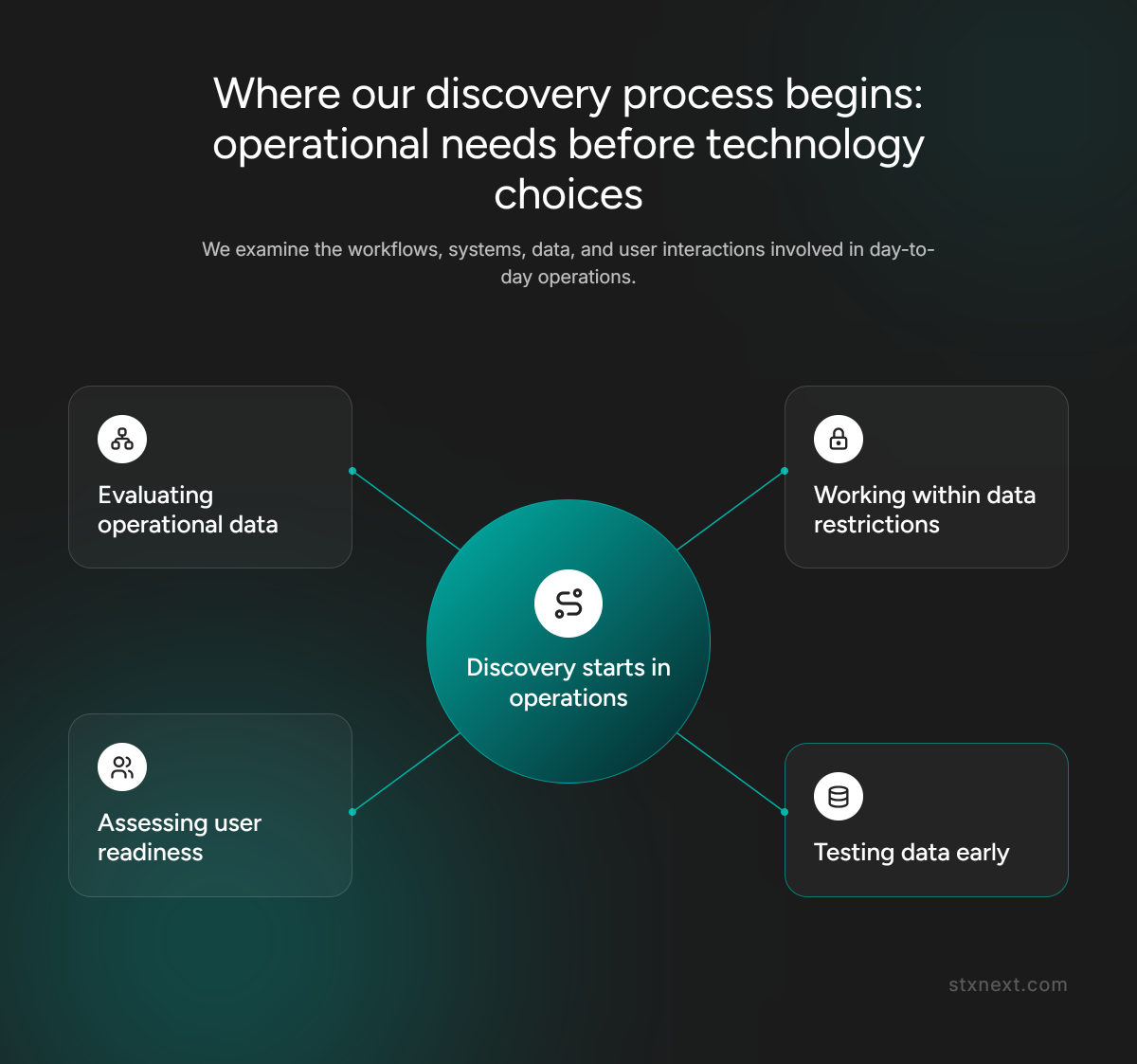
Where our discovery process begins: operational needs before technology choices
Rather than relying solely on a description of the client’s technology stack, our teams examine the workflows, systems, data, and user interactions involved in day-to-day operations.
- Evaluating operational data: We review system interfaces and data flows to identify bottlenecks, quality issues, and gaps between teams or systems. Poor-quality data can undermine automation outputs, while fragmented data and disconnected workflows can limit improvements to a single department instead of the wider process. Without a reliable cross-company data foundation, automation projects often fail to realize their full potential.
- Working within data restrictions: When confidentiality rules prevent access to live records (such as an insurance client restricted from sharing customer files), our consultants work from realistic analogs like public car accident damage photos to test claims-processing requirements.
- Assessing user readiness: Adoption is treated as part of the implementation. We examine how employees use existing tools, where new workflows may create friction, and what support people will need to work effectively with the new system. Targeted user training and AI and automation enablement workshops are integrated directly into our rollout plan.
- Testing data early: We obtain representative samples, whether supplied by the client or sourced through suitable analogues, to evaluate the formats, quality issues, edge cases, and constraints the proposed solution will encounter in practice.
Example: One of our logistics clients (NDA) wanted to automate the processing of scanned and photographed CMR waybills. The original approach assumed OCR needed to be nearly perfect, but higher tech performance couldn’t solve the time constraint without addressing human behavior.
The turning point was understanding how people worked on the ground and redesigning the experience. By combining OCR with an intuitive interface and driving a mindset shift toward an exception-based review workflow, we reduced time spent on the task by around 80% while significantly lowering the error rate.
Validating whether a workflow is ready for AI
Even when a workflow has already been selected, it still needs to be tested before development begins. The key question is whether the process is stable, the data is usable, and the expected outcome is clearly defined for automation.
We assess four areas:
- Measurable business impact: Our target list focuses on workflows that directly move key business metrics, such as increasing production yield to increase revenue or shortening service cycle times which would have otherwise incurred potential penalties or customer churn, rather than minor back-office tweaks that do not affect overall throughput.
- Volume and repeatability: A repetitive manual task performed frequently by 100 employees may be a strong candidate for automation because freeing up that capacity can produce substantial operational savings.
- Process clarity and consistency: Automating a poorly defined or inconsistent process can reproduce the same problems at greater speed. We clarify business rules and simplify the workflow before deciding how automation should be introduced.
- Operational friction and risk: We prioritize workflows where manual data entry repeatedly causes downstream errors or where dependence on a single employee can hold up surrounding teams.
From initial assessment to implementation planning
Once a workflow has been validated, the next step is to decide how it should be implemented and how the solution will fit into day-to-day work.
Custom engineering isn't always the right answer. If an existing capability in Microsoft, SAP, a CRM platform, or another enterprise system can satisfy the requirement, configuring built-in capabilities delivers immediate value without adding new infrastructure to maintain.
The business case should be based on the client’s own operating data rather than generic vendor ROI estimates. We assess factors such as how much employee time the solution could save and how infrastructure, model, and API costs are likely to change as usage grows.
The goal is to determine whether the expected operational improvement justifies the cost of implementation, not to introduce AI where a simpler or less expensive solution would work just as well.
Data readiness and infrastructure auditing for enterprise AI
Data that works for financial reporting or executive dashboards can still be unusable for an AI application. Dashboards typically run on clean, aggregated numbers. An AI system working directly with source documents, customer records, or operational logs is exposed to all the inconsistency that never made it into the dashboard in the first place.
Unfiltered data can also create two accuracy problems: context dilution and context rot. Context dilution occurs when large volumes of irrelevant or weakly related information make it harder for the system to retrieve the details that matter. Context rot occurs when outdated, conflicting, or superseded documents remain available and are treated as current information. Both need to be addressed through data curation, version control, and retrieval design.
Before analyzing file formats or building data pipelines, our technical architects first determine what restrictions apply to the client’s data. This includes:
- Location and storage constraints: Data location affects hosting requirements. Where data is stored and what restrictions apply determine how it can be accessed and processed. Depending on those constraints, information may be available to approved external AI services, accessed through a centralized data platform, or required to remain on client-controlled infrastructure. Backup and recovery arrangements also affect the risk associated with automated data handling.
- Data sovereignty boundaries: We determine which jurisdictions, hosting environments, and external services are permitted to process the data.
- Privacy, compliance, and access control: We identify the privacy, cybersecurity, and access-control requirements that apply to the project. Depending on the client and use case, these may include GDPR requirements for personal data and ICT or cybersecurity obligations under DORA or NIS 2. We also define Role-Based Access Control (RBAC) rules so users can access only the data and functions their role permits.
Checking data formats, variety, and volume
Differences in file formats, languages, units, layouts, and data volumes affect how information needs to be extracted, normalized, stored, and processed. Our technical team reviews sample data to identify these requirements before the architecture is defined. Here are some examples:
- Unstructured variety and normalization: Documents may use different languages, naming conventions, measurement units, or layouts. For one organization, evaluating safety risks across international supplier documents required extracting and translating information while normalizing measurements across units such as cubic meters, liters, and square meters.
- High-volume throughput requirements: Real-time AI automation, such as anomaly detection, depends on data pipelines that can process incoming data quickly enough for the system to act in time. For an industrial manufacturer operating across 11 factories, data readiness meant evaluating legacy ETL constraints to design a streaming architecture capable of handling high-speed telemetry streams (up to 100 million records per day).
Assessing data pipelines & architectural readiness
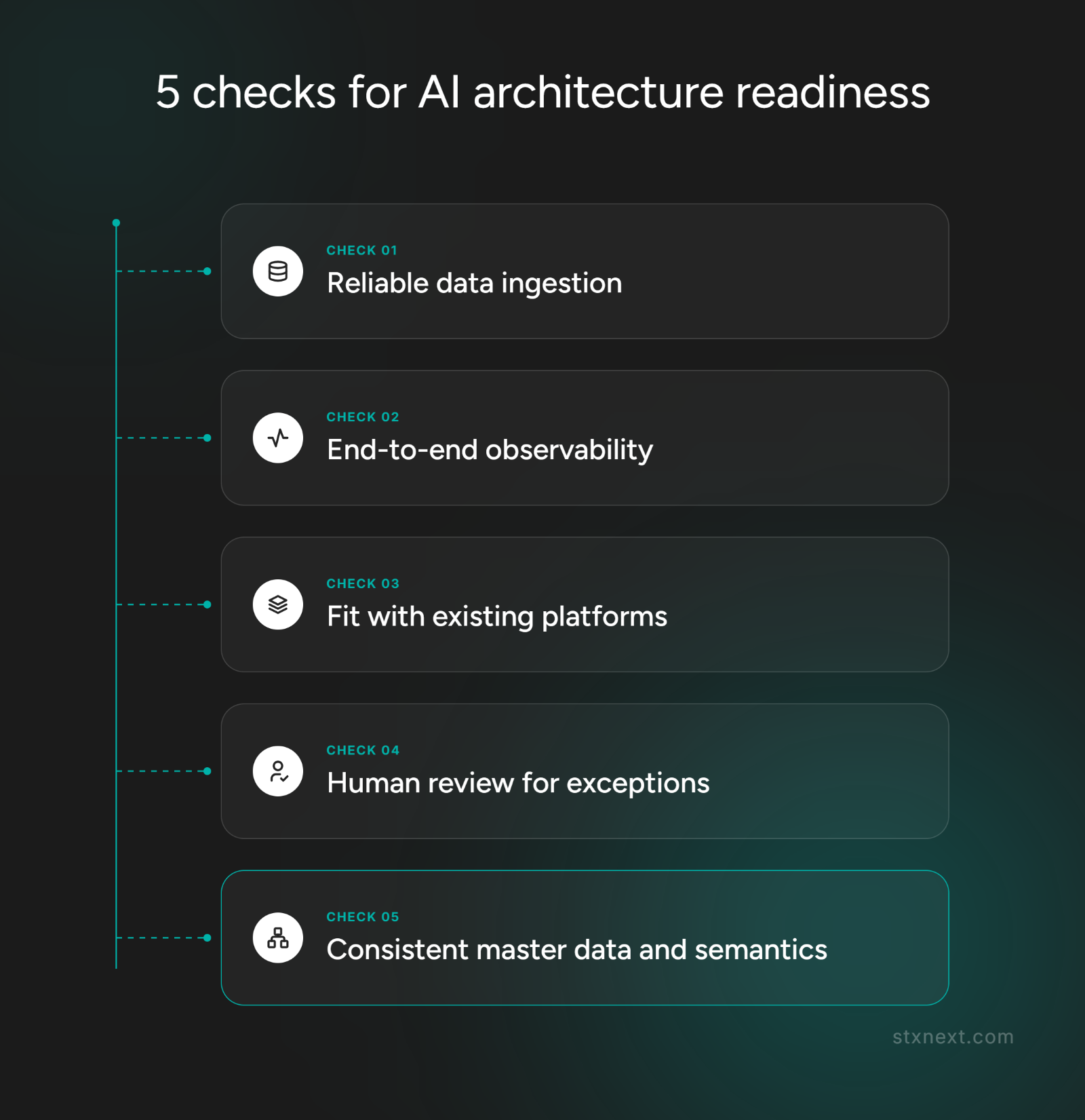
A promising AI use case can still fail if the systems behind it can’t supply reliable data at the required speed or scale. Rather than building production data pipelines, we check whether the existing setup can support production-grade AI or whether the data foundations need to be improved first. Drawing on experience across 100+ data engineering projects, we focus on several core areas:
- Data quality and ingestion risks: Missing fields, schema mismatches, and corrupted records can break ingestion or pass unreliable data downstream. During discovery, we inspect sample records to identify these issues and define the validation rules and quality checks needed as data enters the pipeline.
- Observability and compliance logging: We define what needs to be logged and traced, including source data, model inputs and outputs, tool actions, approvals, and system events.
- Fit with existing systems: An AI use case doesn’t automatically require a new data platform. Through dedicated data lakehouse consulting, we assess whether the client’s existing environment, including platforms such as Databricks, Snowflake, or Microsoft Fabric, can support the required integrations, structured queries, and unstructured indexing for RAG before recommending broader platform changes.
- Human-in-the-loop workflow design: Inputs that fall below defined confidence or validation thresholds need a clear route for review rather than continuing through the workflow automatically. We define the thresholds and routing rules that send these cases to a person while allowing validated cases to continue automatically.
- Semantic layers and master data alignment: When an AI solution relies on business data from multiple systems, conflicting definitions of customers, products, metrics, or other business concepts can lead to inconsistent results. We check whether master data and semantic layers provide consistent definitions or whether they need to be aligned before implementation.
Balancing AI automation with human oversight
Once the data and technical foundations are understood, the next question is how much of the workflow should actually run without human intervention. Full autonomy shouldn’t be the default; the right level depends on the workflow’s risk, reversibility, and volume.
For low-volume or high-risk processes, human checkpoints are often safer and more practical than full automation. At STX Next, we expand autonomy as the system demonstrates reliable performance in production.
Choosing the right level of automation
When evaluating candidate workflows with clients, STX Next weighs three primary operational factors to determine the right level of supervision:
Defining workflow and execution boundaries
Generative AI models can deliver plausible, confident, but entirely incorrect outputs. When an automated system acts on a wrong output without validation, small mistakes compound rapidly down the line.
To manage this risk, STX Next breaks complex workflows into smaller, guarded steps. Instead of giving the AI system end-to-end control, the workflow can generate intermediate outputs, validate key data, and require human confirmation before high-impact actions are triggered.
Discovery also defines clear permission boundaries:
- Data scope requirements: Mapping which data sources, endpoints, and departmental files a model can read versus what must remain restricted.
- Execution permissions: We define which actions can run automatically and which require human approval based on their impact and reversibility. Writing to a database or sending external communications, for example, may require tighter controls than read-only access.
An AI system with read-only database access has a different risk profile from one allowed to write to the database. We define these permissions action by action so the agreed controls are built into the solution from the start.
How STX Next addresses AI security, compliance, and governance during discovery
Generative AI creates risks that standard application security doesn’t fully cover. A system might retrieve sensitive data, cross permission boundaries, follow malicious instructions in documents, or trigger actions through connected tools.
Security therefore needs to be built into the architecture from the start. A wrong answer is a quality issue. Access to data, systems, or actions beyond a user’s permissions is a security failure. STX Next reviews AI security risk across a three-layer model:
While an incorrect model output is a quality issue, a system with overly broad access creates a more serious security risk.
How we plan for data sovereignty, local hosting, and compliance
When a proposed AI system will process regulated or sensitive data, its hosting, access controls, and data flows need to reflect the client’s legal and security requirements:
- Regional and local LLM hosting: When residency or security requirements restrict where data may be processed, STX Next evaluates regional cloud, private-cloud, self-hosted, or client-controlled deployment options.
- Compliance requirements: Applicable regulations can affect data processing, access controls, security measures, documentation, human oversight, and other parts of the system design. STX Next assesses which technical and governance requirements under GDPR, DORA, NIS 2, or the EU AI Act may affect the proposed solution. For candidate screening tools, for example, we assess whether the EU AI Act’s rules for high-risk systems apply and what human-oversight, documentation, and governance requirements would need to be addressed.
- Data licensing and usage rights: Before external content is added to an enterprise knowledge base, we identify licensing, permitted-use, and scraping restrictions that may require legal review.
- Planning for third-party security audits: For applications handling banking, healthcare, or other sensitive data, STX Next incorporates external security reviews into the project roadmap during discovery.
Governance questions to resolve before implementation
Before development begins, both sides need to be clear about what the AI system will be allowed to access, what actions it can take, and where human approval is required. We use five governance questions to define these boundaries:
- Data boundary: What specific data sources, databases, and network drives is our model permitted to read?
- Execution authority: Which external APIs, database writes, or automated actions can our system trigger without prior human approval?
- Trust assumptions: Do we treat all user inputs and retrieved external context as untrusted data by default?
- Auditability: Can engineers and operators trace relevant source data, model inputs and outputs, tool actions, approvals, and system events?
- Compliance alignment: Does our target architecture satisfy your relevant regional hosting, PII handling, and AI Act requirements?
Validating the proposed approach with a working prototype
Instead of asking you to greenlight full-scale engineering based on static documentation alone, our discovery team tests the proposed direction with a working prototype built on real or representative data.
Testing an active flow allows your team to assess user permissions, data movement, and practical UX before committing development effort. It can also reveal operational bottlenecks that a technical review alone may miss.
Tailoring discovery outputs to your project scope
An assessment gives the client a concrete path from initial technical evaluation to full-scale implementation. Because every enterprise project differs in scope, data sensitivity, and technical maturity, STX Next tailors the outputs to clarify what should be built, what needs to be addressed first, and what the implementation will require. These may range from a lean proof-of-concept plan to a detailed enterprise architecture.
Depending on your project requirements, key outputs from a discovery assessment may include:
- Technical blueprint and timeline: A specification mapping business logic, exception handling, resource estimates, and identified risk factors. When preparing for AI-augmented software development, the discovery process can also help shape product requirement documents (PRDs), architecture decision records (ADRs), and implementation plans that organize the context needed for development.
- Prioritized workflow matrix: A ranking of candidate processes by business impact, volume, and technical feasibility to identify where automation is most likely to deliver value.
- Security and compliance boundaries: Custom governance guidelines defining access permissions (Role-Based Access Control), hosting constraints (such as local regional cloud versus dedicated enterprise infrastructure for GDPR and AI Act alignment).
- Human-in-the-loop checkpoints: Operational rules defining where automated models execute independently and where human sign-offs are required to validate system actions.
Why production AI depends on software engineering depth
Discovery can establish that an AI opportunity is worth pursuing and define how the solution should work, but that still leaves the challenge of building it for production. A simple prototype can often be assembled quickly; an enterprise system that operates reliably under real-world traffic requires much deeper software engineering.
A model running in a local test environment tells you very little about how it handles hundreds of concurrent users, rate limits, or corrupted incoming data. Moving from a proof-of-concept to a resilient production environment requires strong engineering foundations:
- Backend scalability: Managing server load, asynchronous processing, memory consumption, and multi-user concurrency without system crashes.
- Legacy system integration: Connecting directly to existing CRMs, ERPs, and client databases without forcing platform migrations.
- Decoupled architecture: Keeping business logic outside model prompts so system rules and APIs remain stable when underlying models change.
- Production safeguards and observability : Enforcing input validation, logging, and observability to catch errors and API failures early.
Ultimately, traditional software engineering depth is what turns fragile AI experiments into secure, maintainable enterprise software.
Moving from AI exploration to execution
The value of enterprise AI doesn’t come from an impressive demo, but from choosing the right problem, checking whether the data and systems can support the solution, and understanding the risks before committing to implementation.
At STX Next, we guide organizations through structured discovery assessments to establish clear engineering parameters before committing to full-scale development. Through technical audit calls, granular architecture specifications, and interactive prototypes built on domain data, we assess where modern automation and AI systems realistically fit into your existing operations.
The result is a clear basis for deciding what to automate, which risks must be controlled, and whether the opportunity justifies full-scale implementation.


