



Intro
A new insurance product, digital service, or AI capability often turns into a much larger development project than expected. Existing systems have accumulated years of customizations and dependencies, so changes that seem straightforward from a business perspective involve modifications across several applications.
That means even more development and testing, and longer delivery times.
As insurance businesses invest in AI and expand their digital services, these limitations become harder to ignore. Capgemini's Insurance Top Trends 2026 report mentions that 72% of insurers consider data integration with legacy systems a significant barrier to innovation.
The question is where to make changes without creating even more complexity. The goal of insurance platform modernization is to make it easier to introduce new products and services without every change turning into a costly, cross-system development project.
Why legacy insurance platforms slow down development
Insurance businesses have spent years adapting their platforms to support new products, processes, and distribution channels. That often meant adding custom functionality or connecting another application rather than replacing systems that were already in use.
As these changes accumulate, even relatively small updates become harder to deliver. Introducing a new insurance product, for example, may require modifications to policy administration, rating, billing, and reporting systems.
But launching products isn't the only concern. The older and more interconnected the systems become, the harder they are to maintain. Some still rely on unsupported frameworks or integrations that nobody has fully documented.
Others hold data in formats that newer applications can’t easily use. These problems become particularly relevant when a business wants to introduce AI capabilities, connect new digital services, or address vulnerabilities discovered during a security audit.
Where existing platforms create problems
The system where a problem becomes visible isn't always the one causing it. A company might assume its policy administration platform is slowing down product launches, when the delays actually come from how it exchanges data with other applications or how changes are tested.
Modernization starts with identifying the source of delays rather than deciding which system to replace. Otherwise, a business risks investing in a new platform while leaving the original bottlenecks untouched.
How much of your insurance platform needs modernization?
A platform that still handles essential operations reliably doesn't automatically require replacement. On the other hand, keeping outdated technology becomes expensive when every new requirement brings another workaround or custom integration.
The question is which parts of the platform are still doing their job and which ones are making every new project harder.
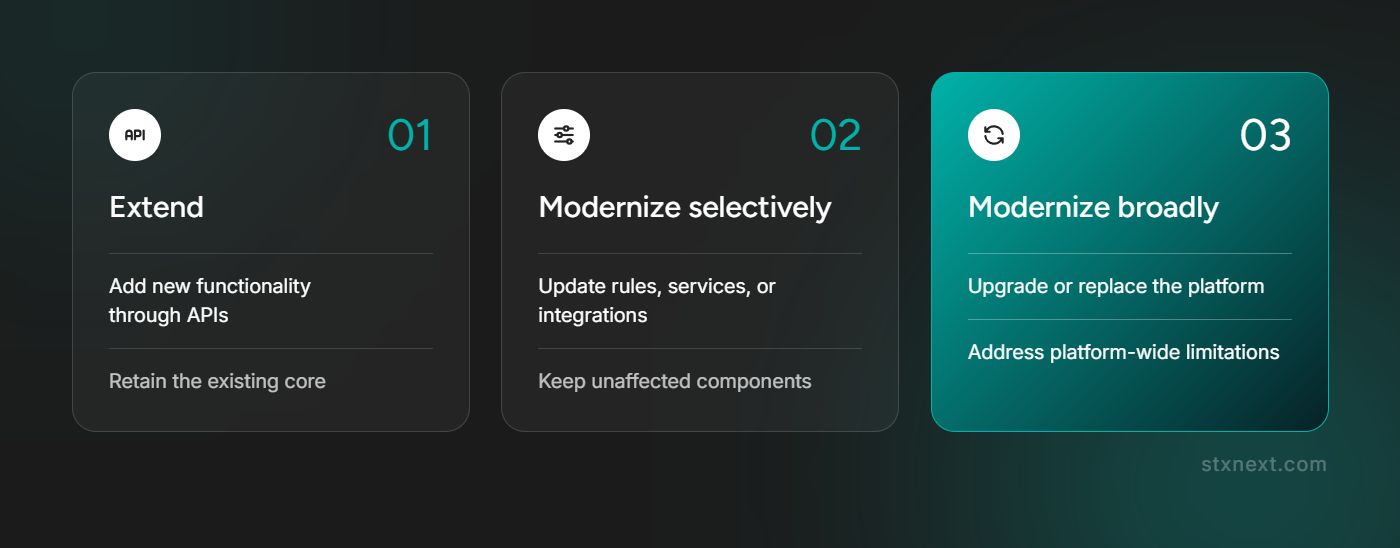
Depending on where the limitations lie, modernization can involve extending the legacy core, changing selected components, or taking a broader approach.
Keep the core and extend its capabilities
Does a new customer portal really require replacing the policy administration system? Often, it’s not the case.
Consider an insurance business introducing self-service features for policyholders. Instead of replacing its policy administration system, it develops a separate portal that connects to the core through APIs. Customers are able to view their policies, update personal details, or submit service requests, while the current system continues to manage policy records and transactions.
This approach works well when the core provides reliable access to the data and functionality the new service needs. But if every new feature requires extensive changes to the core or additional custom integrations, keeping the existing architecture becomes harder to justify.
Modernize the components holding back development
Sometimes one part of the platform causes most of the delays.
For example, an insurance company has a policy administration system that works reliably, but product updates take too long because pricing and underwriting rules are hardcoded.
Engineers first examine where those rules are implemented, which applications depend on them, and how they affect current products. This helps establish whether a configurable component would simplify future updates without replacing the rest of policy administration.
In some cases, the problem lies in how tightly different functions are connected. Separating functionality into a dedicated service allows teams to develop, test, and deploy changes more independently, provided the service boundaries reflect existing business rules and dependencies.
Other candidates for targeted modernization include outdated integration components, customer-facing applications, and services that require frequent updates. When replacing or upgrading them, engineers have to define how they connect to the rest of the platform and who is responsible for maintaining them. Otherwise, modernization simply adds new dependencies to manage.
Plan broader modernization when problems affect the entire platform
When dependencies extend across the platform and targeted improvements offer little benefit, broader modernization becomes worth considering.
The business then has to decide whether to upgrade its existing platform or replace it. If replacement is necessary, another decision follows: adopt a commercial product or develop a custom solution.
- Upgrade the existing platform. This preserves the current system and much of its functionality, but extensive customizations and integrations make upgrades more complicated. It doesn't necessarily resolve all existing limitations.
- Replace it with a commercial platform. The vendor maintains the standard product, while the business manages its integrations, configurations, and customizations. Adopting the new software also involves adapting existing processes to its capabilities.
- Develop a custom solution. This provides greater control over functionality and architecture, but the business takes responsibility for ongoing development, maintenance, and upgrades.
The amount of work involved in moving to a new platform affects the decision. Replacing core functionality means migrating data, preserving business rules, rebuilding integrations, and keeping essential operations running throughout the transition. The costs and risks have to be weighed against the benefits of replacing the existing system.
At STX Next, we help insurance businesses modernize legacy applications, improve integrations, and develop digital platforms. Explore our insurance software development services to learn more.
Decide what to modernize
Before deciding what to modernize, assess the observability of the legacy platform. Metrics, logs, traces, and alerts help teams identify slow response times, recurring errors, and integration failures before they affect customers.
They help reveal problems in business operations, such as failed transactions or reconciliation issues. Without such baseline, it's harder to prioritize improvements, detect problems during the transition, or tell whether modernization has delivered better results.
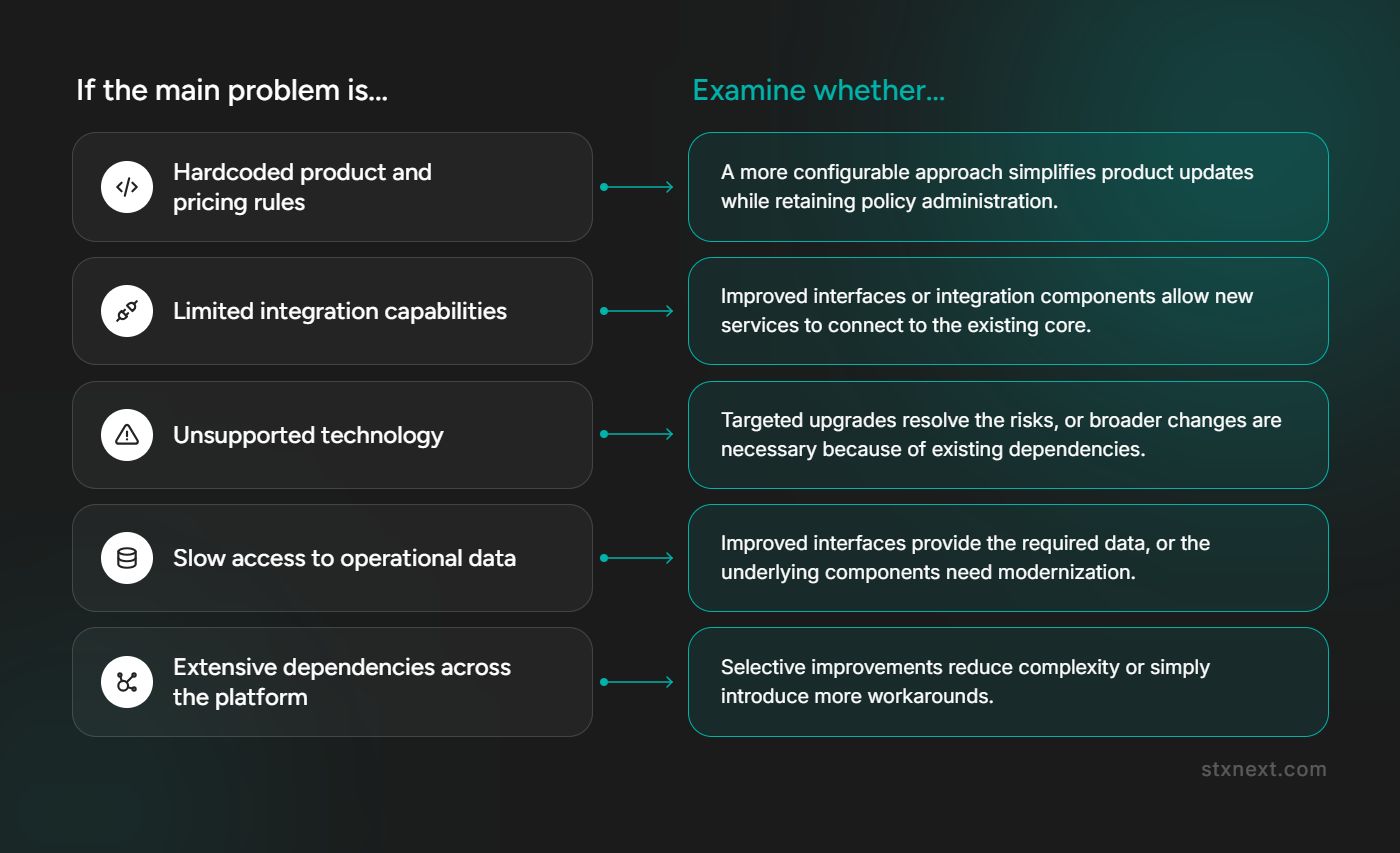
Once the technical options are clear, compare them against business priorities, costs, and risks.
- Business priorities. Which products, services, or processes are being held back?
- Technical dependencies. Which components require changes, and what else relies on them?
- Long-term costs. How does maintaining the current platform compare with upgrading or replacing it?
- Internal expertise and ownership. Who understands the systems, and who will document, operate, and maintain the modernized platform?
- Operational and regulatory risks. What are the consequences of keeping or replacing the technology?
- Expected improvements. How much faster should product changes, integrations, or releases become? What reduction in maintenance effort would justify the investment?
How do insurance businesses modernize without disrupting operations?
Insurance platforms support processes that must continue during modernization. Replacing an application means accounting for the systems, data, and employees that depend on it.
Understand the existing processes and dependencies
Changes to a policy administration system affect billing, reporting, customer service, and other connected applications. Not all these dependencies are documented.
The same applies to business processes. Customer support and operations teams often handle manual corrections and unusual requests outside standard workflows. Speaking with employees helps engineers establish how such cases are resolved and why manual intervention is necessary.
Modernization offers an opportunity to improve exception handling. Recurring cases can become part of standard workflows, while more unusual situations still require human judgment. Clear rules and audit trails make decisions easier to track and review, reducing reliance on ad hoc workarounds.
For a closer look at which processes to improve or automate, see our guide to insurance workflow automation.
Using AI to understand and modify legacy code
The technical investigation goes beyond process documentation. Engineers examine the code to see how business rules are implemented, especially when the original documentation is incomplete.
AI helps them navigate unfamiliar applications, trace dependencies, and prepare code updates. Yet it sometimes overlooks important business rules, struggles with outdated frameworks, or proposes solutions that don't reflect what the business wants to achieve.
Modernization is an opportunity to improve existing processes, not simply reproduce them in new software. Engineers work with Product teams to decide which business rules to preserve, what to improve, and how the updated functionality will work. These decisions guide development and help teams review and test AI-generated code.
Introduce changes gradually
Rather than replace functionality for everyone at once, start with a limited group of customers or transactions.
During a policy servicing upgrade, for example, the team verifies that transactions are handled correctly and resolves issues before expanding the release. Employees gain time to become familiar with the updated application.
Test the complete workflow
An application can pass its own tests and still cause problems in connected systems.
Take a claims administration upgrade. The new application handles claims correctly, but changes to the data it produces affect document processing, financial reporting, and other applications. Testing covers the wider workflow, including the accuracy of migrated records and consistency of data across systems.
Some problems only become apparent in production. Test environments don't always reproduce external integrations or real operating conditions, especially when older third-party APIs have limited documentation or vendor support. Engineers identify these gaps and establish how to validate the affected processes before release.
Complete the transition to the new functionality
Even after testing, moving a new application into daily operations brings additional risks. During phased modernization, old and new systems often run in parallel, each handling different processes.
When both applications work with related data, teams have to establish which system holds the authoritative records and how information moves between them. Without that coordination, conflicting records and reporting errors occur. BI teams verify that reports use the correct data sources, as outdated feeds sometimes trigger false alarms.
As processes move to the new application, customer support, operations, and finance teams need clear guidance on what has changed, which system to use for each task, and where to find the information they rely on.
Once the replacement operates reliably and the necessary data and processes have been transferred, the old functionality can be retired. Otherwise, the business continues maintaining overlapping applications and their integrations.
What to verify before expanding the rollout
Before introducing changes to more customers, products, or processes, check the following.
- Business functionality. Are transactions, rules, and exceptions handled correctly?
- Integrations. Do connected applications exchange the expected data?
- Data accuracy. Have migrated records been reconciled, and is synchronized data consistent?
- Reporting. Do operational and financial reports reflect transactions correctly?
- Observability. Are logs, metrics, and alerts in place to detect failures and investigate problems after deployment?
- Operational readiness. Are employees prepared to work with the updated processes?
- Recovery. Have failure scenarios and recovery procedures been tested?
- Retirement. Is there a plan to remove the old functionality once the transition is complete?
Technical tests verify that the software works as expected, while business teams check that employees are able to complete their tasks correctly before the rollout expands.
What should insurance platform modernization achieve?
Replacing outdated technology won't accomplish much if the new platform inherits the same dependencies, difficult integrations, and maintenance problems.
The results become visible in everyday engineering work. Routine changes affect fewer applications, teams spend less time maintaining custom integrations, and releases become more predictable. New functionality fits into the architecture without requiring another round of workarounds.
That's ultimately how to judge the investment: by whether the platform becomes easier to maintain, extend, and adapt as business requirements change.


